The Tampa Bay Lightning re-signed restricted free-agent defenseman Mikhail Sergachev to a three-year deal carrying an average annual value of $4.8 million, the team announced Wednesday.
Tampa Bay is now a projected $1.9 million over the salary cap and still needs to sign center Anthony Cirelli and defenseman Erik Cernak, who are both RFAs, according to PuckPedia.
Sergachev recorded 10 goals and 24 assists in 70 games last season and added 10 points in 25 playoff contests en route to the Lightning's Stanley Cup triumph.
The 22-year-old hasn't been tasked with playing tough minutes, as those responsibilities generally fall on Victor Hedman's or Ryan McDonagh's pairing. However, the Russian has vastly outperformed his matchups, ranking in the 81st percentile in offensive play driving and 92nd percentile in defensive play driving, according to The Athletic's Dom Luszczyszyn's model.
Given what I wrote earlier this week, my model unsurprisingly likes this deal for Tampa Bay, giving Sergachev a 91 percent chance of outperforming it. pic.twitter.com/XDw1LPzONA
Additionally, Sergachev has posted an expected goals share above 53% in all three of his NHL seasons, according to Natural Stat Trick. His 58.6% expected goals share was second-best among Lightning blue-liners during the postseason.
The Montreal Canadiens drafted Sergachev ninth overall in 2016, but traded him to Tampa Bay along with a second-round pick the following offseason in exchange for forward Jonathan Drouin and a sixth-round pick.
A skate clipped the veteran blue-liner's face during a game in March, requiring 90 stitches to repair the cut. He missed the rest of the regular season but returned for three playoff games.
"I knew there was something going on but I didn't want to think about it because I wanted to play," he said Wednesday, according to The Athletic's Arthur Staple. "You try to play through everything, and I did."
Boychuk says he was diagnosed with optic nerve damage and "some other stuff." Had the initial diagnosis right after the playoffs ended, been seeing doctors regularly since.
Boychuk, who'll turn 37 in January, played parts of 13 seasons in the NHL and spent the last six with New York. He won the Stanley Cup with the Boston Bruins in 2011, and the Bruins traded him to the Islanders on the eve of the 2014-15 season.
Known for his ability to tee up blistering and accurate slap shots, the longtime rearguard produced 54 goals and 206 points in 725 contests.
The Colorado Avalanche selected Boychuk 61st overall in 2002.
While there are still plenty of available unrestricted free agents, several unsigned restricted free agents, and a handful of players who could potentially be dealt, theScore is handing out offseason grades for each NHL team.
Wednesday's edition focuses on the Metropolitan Division, which was uncharacteristically quiet.
Some contract figures are reported. Most players on two-way deals have been omitted.
Carolina Hurricanes
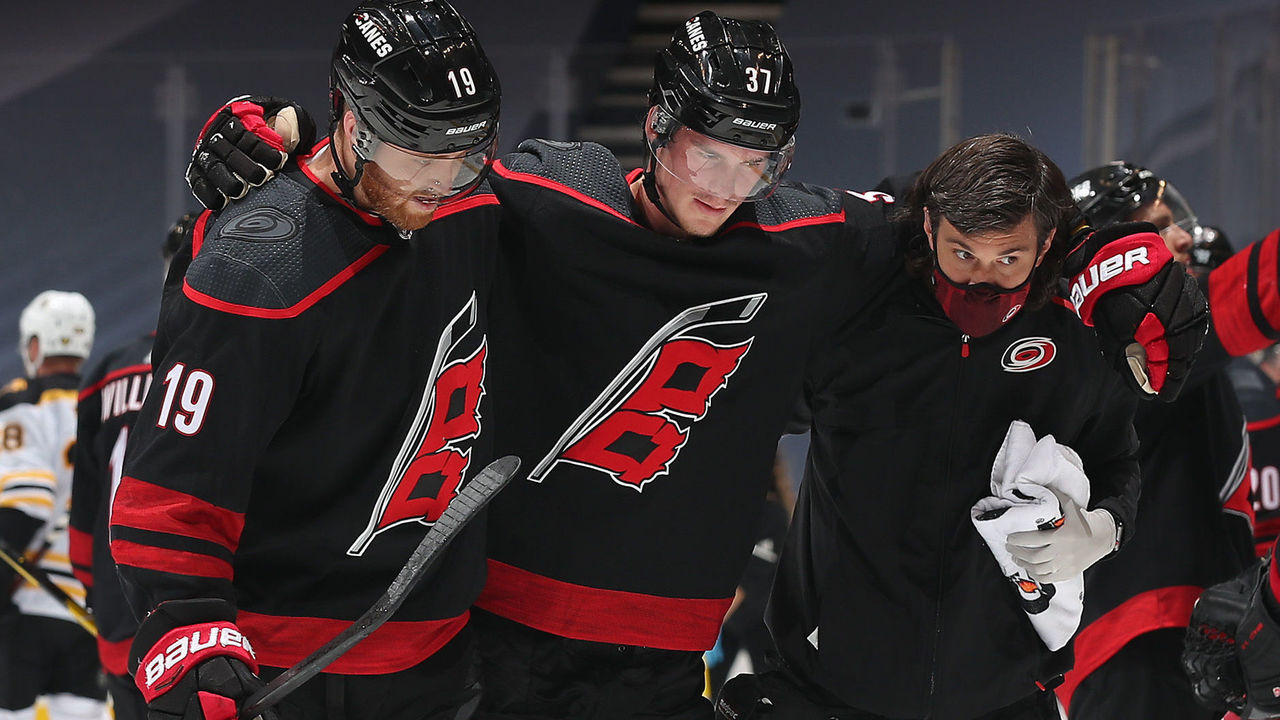
Chase Agnello-Dean / National Hockey League / Getty
Key arrivals
Player
Position
Contract Length
AAV
Jesper Fast
F
3 years
$2M
Drew Shore
F
1 year
$700K
Joakim Ryan
D
1 year
$700K
Key departures
Player
Position
Transaction
Justin Williams
F
Retired
Sami Vatanen
D
Unsigned UFA
Joel Edmundson
D
Traded to MTL
Trevor van Riemsdyk
D
Signed with WSH
Re-signed
Player
Position
New Contract Length
AAV
Warren Foegele
F
1 year
$2.15M
Haydn Fleury
D
2 years
$1.3M
Rookies who could crack the lineup
Player
Position
Drafted
Morgan Geekie
F
3rd round (2017)
Dominik Bokk
F
1st round (2018 - STL)
Jake Bean
D
1st round (2016)
The Hurricanes were rather quiet this offseason. Fast is a strong play-driver and should be a nice fit for Rod Brind'Amour's group, but when he's a team's most notable addition, you know not much has changed.
On the blue line, Edmundson and van Riemsdyk won't be missed considering how much depth the club has. However, general manager Don Waddell might be regretting his trade for Brady Skjei ($5.25 million in average annual value for four more seasons) at the 2020 deadline and signing Jake Gardiner ($4.05 million in AAV for three more seasons) last offseason.
Those contracts could make it difficult to re-sign Dougie Hamilton, who's set to hit unrestricted free agency next offseason when Andrei Svechnikov's entry-level deal expires. Waddell loses marks for not getting out ahead of his 2021 cap dilemma.
This is still a solid team that should improve as young players continue to develop, but the goaltending duo of James Reimer and Petr Mrazek remains suspect.
Grade: C
Columbus Blue Jackets
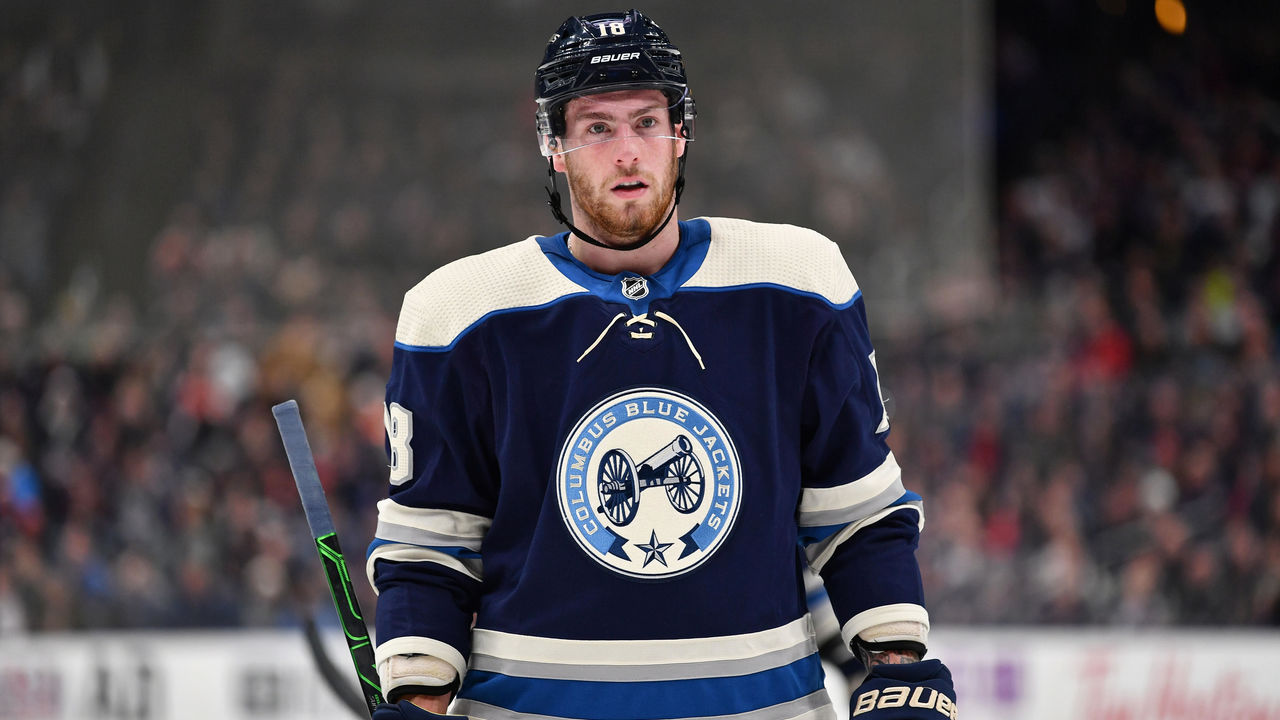
Jamie Sabau / National Hockey League / Getty
Key arrivals
Player
Position
Contract Length
AAV
Max Domi
F
2 years
$5.3M AAV (trade with MTL)
Mikko Koivu
F
1 year
$1.5M
Mikhail Grigorenko
F
1 year
$1.2M
Key departures
Player
Position
Transaction
Josh Anderson
F
Traded to MTL
Alexander Wennberg
F
Bought out
Ryan Murray
D
Traded to NJ
Markus Nutivaara
D
Traded to FLA
Re-signed
Player
Position
New Contract Length
AAV
Vladislav Gavrikov
D
3 years
$2.8M
Gabriel Carlsson
D
2 years
$725K
Elvis Merzlikins
G
2 years
$4M
Joonas Korpisalo
G
2 years
$2.8M
Unsigned RFAs
Player
Position
Pierre-Luc Dubois
F
Rookies who could crack the lineup
Player
Position
Drafted
Liam Foudy
F
1st round (2018)
Blue Jackets GM Jarmo Kekalainen addressed his biggest need this offseason: depth down the middle. The additions of Domi, Koivu, and Grigorenko will allow Boone Jenner and Nick Foligno to play on the wing where they're most valuable. However, all these players have question marks.
Is Columbus getting the 72-point Domi from 2018-19 or the 44-point Domi from 2019-20? He'll almost certainly be more valuable than Anderson, who produced just four points over 26 games during an injury-riddled campaign last season. However, Anderson is the better player when healthy.
Grigorenko is a high-upside, low-risk addition. The former first-round pick has plenty of skill but was never able to put it all together in the NHL. Can he be a key contributor after three years in the KHL? Additionally, what does the 37-year-old Koivu have left in the tank?
The blue line's top six remains solid, but the depth took a hit with the losses of Murray and Nutivaara. That could be problematic in a condensed schedule.
It's difficult to give the Blue Jackets a high grade considering their No. 1 objective coming into the offseason had to be getting Dubois locked up, and they've yet to do that despite having over $9 million in cap space.
Grade: C+
New Jersey Devils
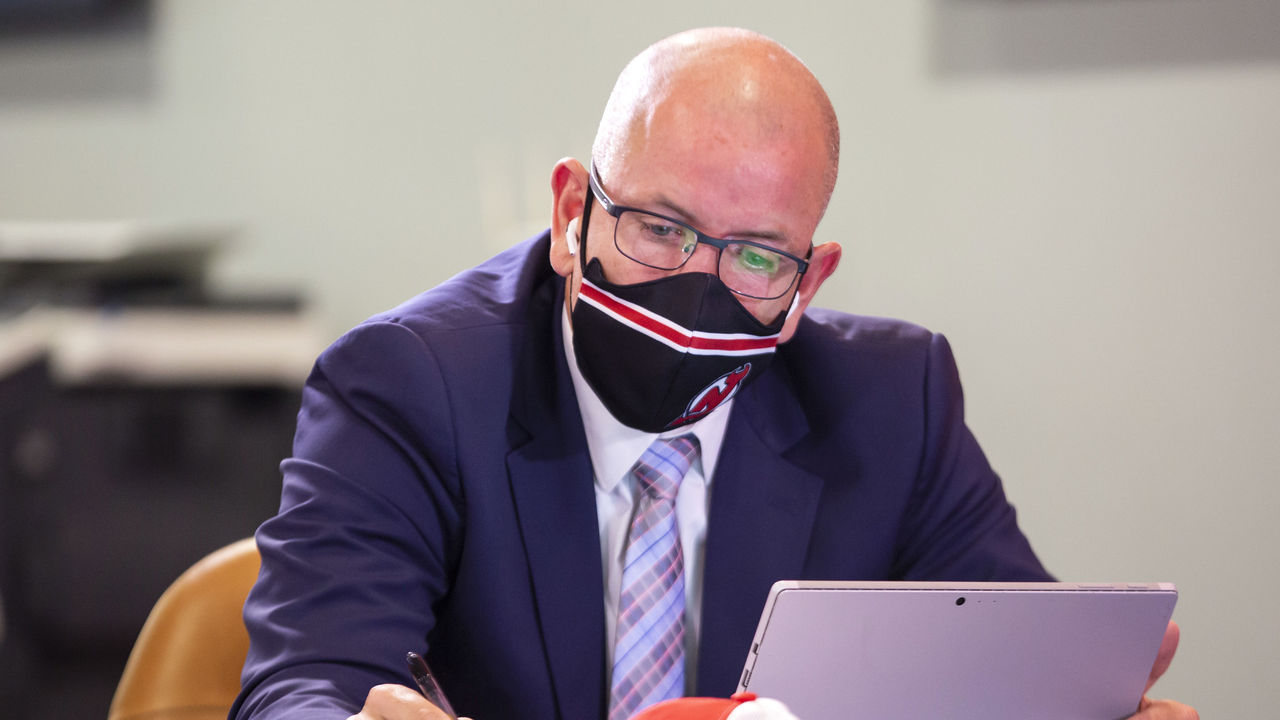
NHL Images / National Hockey League / Getty
Key arrivals
Player
Position
Contract Length
AAV
Andreas Johnsson
F
3 years
$3.4M (trade with TOR)
Ryan Murray
D
1 year
$4.6M (trade with CLB)
Dmitry Kulikov
D
1 year
$1.15M
Corey Crawford
G
2 years
$3.9M
Key departures
Player
Position
Transaction
Joey Anderson
F
Traded to TOR
Kevin Rooney
F
Signed with NYR
Mirco Mueller
D
Unsigned UFA
Cory Schneider
G
Unsigned UFA
Unsigned RFAs
Player
Position
Jesper Bratt
F
MacKenzie Blackwood
G
Rookies who could crack the lineup
Player
Position
Drafted
Nolan Foote
F
1st round (2019 - TB)
Nick Merkley
F
1st round (2015 - ARI)
Alexander Holtz
F
1st round (2020)
Ty Smith
D
1st round (2018)
Kevin Bahl
D
2nd round (2018 - ARI)
As one of the few clubs with cap flexibility, the Devils were able to make some savvy trades with teams looking to clear cap space. They acquired a solid middle-six winger in Johnsson and a legitimate top-four defenseman (when healthy) in Murray while only giving up Anderson and a fifth-round pick. That's some nice work by new GM Tom Fitzgerald.
Fitzgerald also solidified his goaltending by adding Crawford on a fair deal. The veteran netminder proved in the playoffs he can still perform at a high level.
While New Jersey has two RFAs to sign, the team has over $17 million in cap space to use. The Devils get docked for not being even more aggressive considering their cap space and the remaining UFAs that could help fill the holes on this roster, specifically up front.
The hiring of Lindy Ruff as New Jersey's head coach was a questionable move, but all and all it was a stellar offseason for the Devils.
Grade: B
New York Islanders
Mark Blinch / National Hockey League / Getty
Key arrivals
Player
Position
Contract Length
AAV
Ilya Sorokin
G
1 year
$2M
Key departures
Player
Position
Transaction
Derick Brassard
F
Unsigned UFA
Matt Martin
F
Unsigned UFA
Tom Kuhnhackl
F
Unsigned UFA
Johnny Boychuk
D
Career over (eye injury)
Devon Toews
D
Traded to COL
Andy Greene
D
Unsigned UFA
Thomas Greiss
G
Signed with DET
Re-signed
Player
Position
New Contract Length
AAV
Josh Ho-Sang
F
1 year
$700K
Ryan Pulock
D
2 years
$5M
Unsigned RFAs
Player
Position
Mathew Barzal
F
Rookies who could crack the lineup
Player
Position
Drafted
Oliver Wahlstrom
F
1st round (2018)
Kieffer Bellows
F
1st round (2016)
Lou Lamoriello has put the Islanders in quite a pickle. Thanks to some contracts he's signed since arriving in Long Island two years ago (most notably Jordan Eberle, Jean-Gabriel Pageau, and Leo Komarov), New York is up against the cap. Signing Barzal looked like a near-impossible task, but getting $6 million in relief by placing Boychuk on LTIR will likely help the team ink the franchise center.
However, the Islanders still had to move Toews, 26, who was their second-best defenseman last year, and they only received a pair of second-round picks in return. That's a massive loss.
With no improvements up front or on defense, this offseason can only be considered a disaster - especially while Barzal remains unsigned. The only thing saving this grade from an F was convincing Sorokin to leave the KHL six years after the Isles drafted him.
Grade: D
New York Rangers
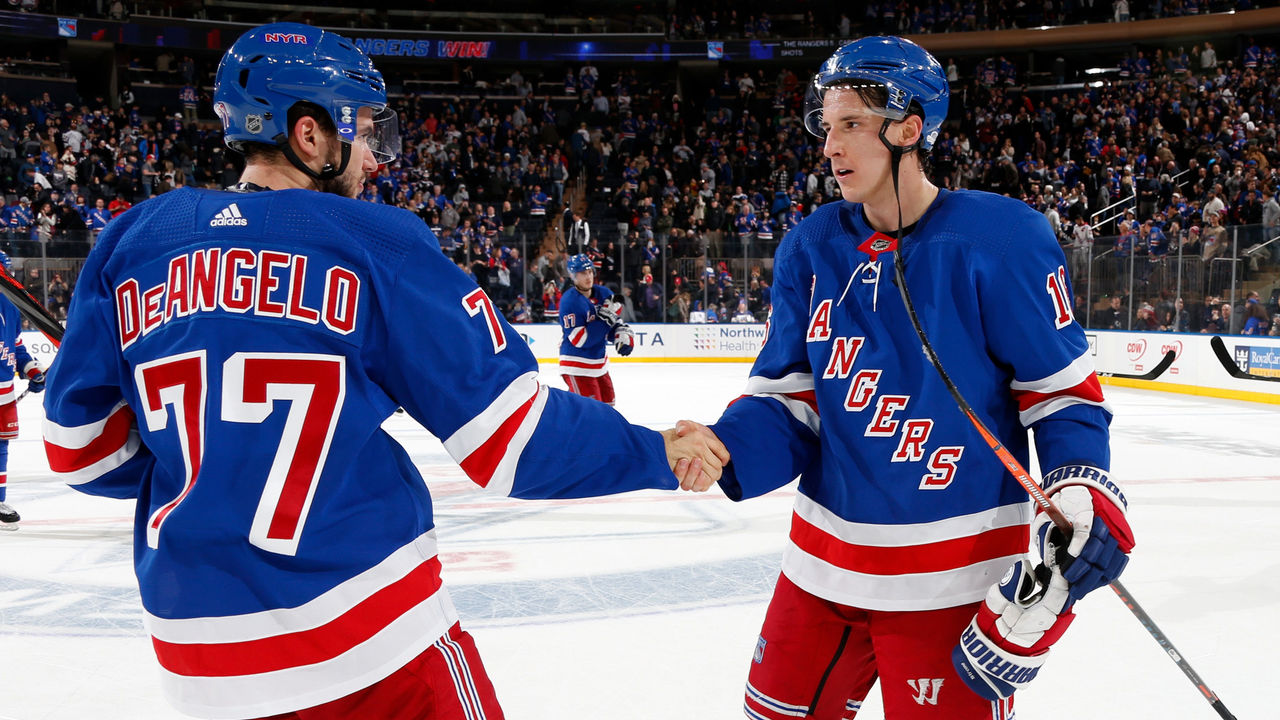
Jared Silber / National Hockey League / Getty
Key arrivals
Player
Position
Contract Length
AAV
Kevin Rooney
F
2 years
$750K
Jack Johnson
D
1 year
$1.15M
Anthony Bitetto
D
2 years
$738K
Key departures
Player
Position
Transaction
Jesper Fast
F
Signed with CAR
Lias Andersson
F
Traded to LA
Marc Staal
D
Traded to DET
Henrik Lundqvist
G
Signed with WSH
Re-signed
Player
Position
New Contract Length
AAV
Ryan Strome
F
2 years
$4.5M
Brendan Lemieux
F
2 years
$1.55M
Tony DeAngelo
D
2 years
$4.8M
Alexandar Georgiev
G
2 years
$2.425M
Rookies who could crack the lineup
Player
Position
Drafted
Alexis Lafreniere
F
1st round (2020)
Vitali Kravtsov
F
1st round (2018)
K'Andre Miller
D
1st round (2018)
One year after being one of the busiest teams in free agency, the Rangers were rather quiet in 2020. Aside from buying out a franchise icon in Lundqvist, the team made no significant moves.
After making an addition by subtraction by shipping Staal to the Red Wings, GM Jeff Gorton replaced him with one of the few defensemen worse than Staal: Jack Johnson. The former third overall pick is a below-replacement-level blue-liner. His $1.15-million cap hit won't kill New York, but it all but guarantees Johnson a spot on the team's bottom pair. Better options could've been had for under $1 million.
The Rangers have ample firepower up front, one of the league's best, young, cost-efficient goaltending duos, and a strong right side of the blue line. However, the left side of the blue line (Ryan Lindgren, Libor Hajek, Brendan Smith, Johnson, and Bitetto) is one of the NHL's worst. If New York misses the playoffs, it will likely be because of Gorton's failure to address this issue.
Lafreniere could be an immediate impact player, but the Rangers shouldn't get credit because a ping pong ball bounced their way.
Grade: D
Philadelphia Flyers
Icon Sportswire / Icon Sportswire / Getty
Key arrivals
Player
Position
Contract Length
AAV
Erik Gustafsson
D
1 year
$3M
Key departures
Player
Position
Transaction
Tyler Pitlick
F
Signed with ARI
Derek Grant
F
Signed with ANA
Nate Thompson
F
Signed with WPG
Matt Niskanen
D
Retired
Re-signed
Player
Position
New Contract Length
AAV
Nolan Patrick
F
1 year
$874K
Nicolas Aube-Kubel
F
2 years
$1.075M
Oskar Lindblom
F
3 years
$3M
Justin Braun
D
2 years
$1.8M
Robert Hagg
D
2 years
$1.6M
Brian Elliott
G
1 year
$1.5M
Unsigned RFAs
Player
Position
Philippe Myers
D
Rookies who could crack the lineup
Player
Position
Drafted
Morgan Frost
F
1st round (2017)
German Rubtsov
F
1st round (2016)
Mark Friedman
D
3rd round (2014)
It cannot be understated how big the loss of Niskanen is. The veteran was the perfect partner for Ivan Provorov on the team's top pairing, and he flourished against tough matchups.
The signing of Gustafsson was curious. It seemed to spell the end of Shayne Gostisbehere's time in the City of Brotherly Love - given the prior rumors - but he remains in Philadelphia. Gustafsson and Gostisbehere have high offensive ceilings, but both are defensive liabilities and aren't suited to play alongside Provorov. In hindsight, Gustafsson at $3 million seems like a slight overpay, depending on what UFA D-men Travis Hamonic and Sami Vatanen sign for.
The Flyers have a deep crop of forwards and arguably the best young goaltender in the game, but if Myers can't step into the top-pairing role with Provorov, GM Chuck Fletcher is going to wish he did a better job replacing Niskanen. Thankfully, Philadelphia has a bit of wiggle room, so a defenseman could potentially be acquired during the season if things go south.
Grade: C-
Pittsburgh Penguins
Dave Sandford / National Hockey League / Getty
Key arrivals
Player
Position
Contract Length
AAV
Kasperi Kapanen
F
2 years
$3.2M (trade with TOR)
Colton Sceviour
F
1 year
$1.2M (trade with FLA)
Mark Jankowski
F
1 year
$700K
Mike Matheson
D
6 years
$4.875M (trade with FLA)
Cody Ceci
D
1 year
$1.25M
Key departures
Player
Position
Transaction
Patric Hornqvist
F
Traded to FLA
Nick Bjugstad
F
Traded to MIN
Conor Sheary
F
Unsigned UFA
Patrick Marleau
F
Signed with SJ
Justin Schultz
D
Signed with WSH
Jack Johnson
D
Bought out
Matt Murray
G
Traded to OTT
Re-signed
Player
Position
New Contract Length
AAV
Jared McCann
F
2 years
$2.94M
Sam Lafferty
F
2 years
$750K
Evan Rodrigues
F
1 year
$700K
Chad Ruhwedel
D
1 year
$750K
Tristan Jarry
G
3 years
$3.5M
Rookies who could crack the lineup
Player
Position
Drafted
Samuel Poulin
F
1st round (2019)
Pierre-Olivier Joseph
D
1st round (2017 - ARI)
The Penguins were easily the busiest team in their division this offseason, but that doesn't necessarily mean they're the most improved.
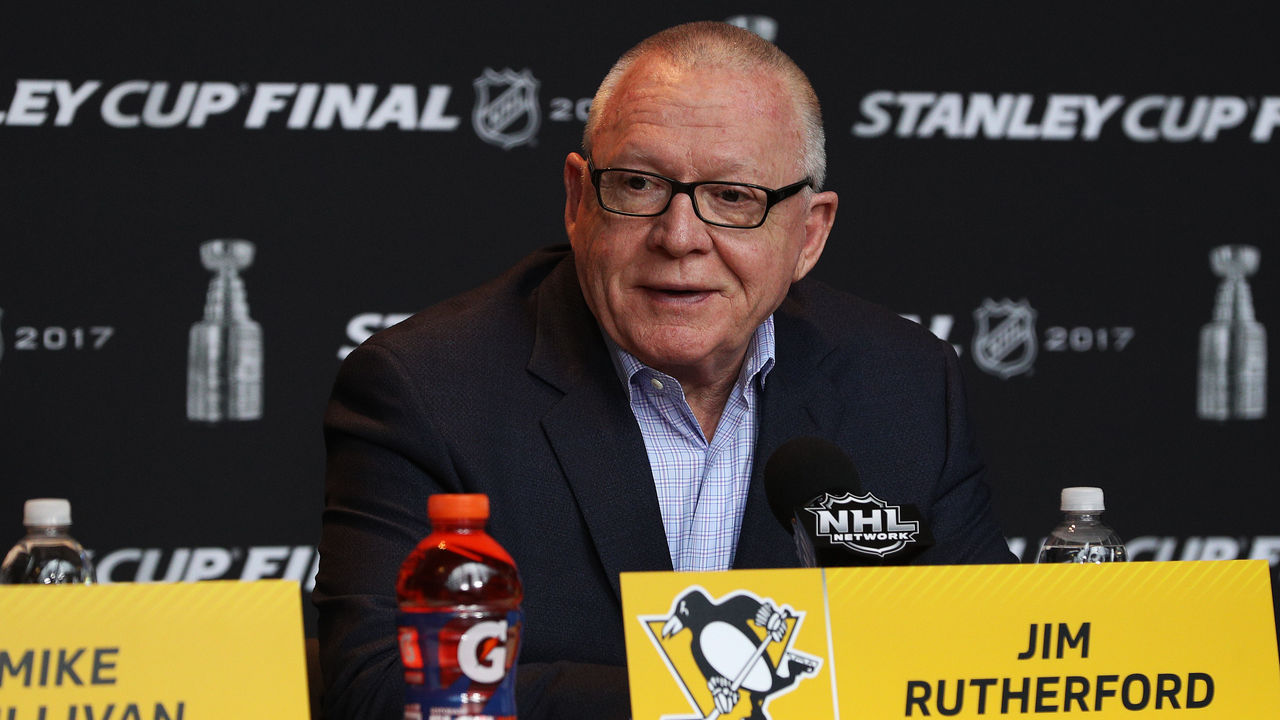
GM Jim Rutherford drafted Kapanen and his father, Sami, but a first-round pick and a solid prospect in Filip Hallander was a steep price to pay for a player who's yet to prove he can flourish as a top-six forward.
Kapanen will essentially replace Hornqvist - a gritty, heart-and-soul player - in the top six. Hornqvist's contract ($5.3 million in AAV for three more years) wasn't great, but swapping it for Matheson's deal could be problematic. Matheson is a turnover machine who's posted a sub-50% expected goals share in four straight seasons. He's a third-pairing blue-liner at best.
In what seemed like an attempt to make Pittsburgh's defense even worse, Rutherford signed Ceci, one of the league's worst blue-liners. His possession numbers were better this past season in Toronto after six years in Ottawa, but he's still a liability. He won't be counted on to play top-four minutes in Pittsburgh, but it's still a questionable signing.
On the bright side, Jankowski and Sceviour are solid bottom-six additions and offer good value.
Grade: D+
Washington Capitals
Mark Blinch / National Hockey League / Getty
Key arrivals
Player
Position
Contract Length
AAV
Justin Schultz
D
2 years
$4M
Trevor van Riemsdyk
D
1 year
$800K
Henrik Lundqvist
G
1 year
$1.5M
Key departures
Player
Position
Transaction
Ilya Kovalchuk
F
Unsigned UFA
Radko Gudas
D
Signed with FLA
Braden Holtby
G
Signed with VAN
Re-signed
Player
Position
New Contract Length
AAV
Brenden Dillon
D
4 years
$3.9M
Jonas Siegenthaler
D
1 year
$800K
Rookies who could crack the lineup
Player
Position
Drafted
Connor McMichael
F
1st round (2019)
GM Brian MacLellan had very little cap room to work with this offseason, and it was a foregone conclusion that the forward group was going to go mostly untouched.
However, the Capitals had some flexibility with regards to their defense and goaltending. Schultz was an interesting addition. Washington had the league's second-best offense but the 15th-ranked defense. Targeting more of a defensive defenseman would've made sense, but Schultz doesn't exactly fit that description. He's more of a high-variance offensive blue-liner.
Washington's best move of the offseason, though, was re-signing Dillon. The rugged defenseman has posted strong possession numbers in his career and performed well with the Caps - specifically alongside John Carlson - after being acquired at the trade deadline. The value is reasonable, too.
In goal, Lundqvist was a decent value signing (he probably won't be worse than Holtby was at $6.1 million last year). "King Henrik" will be playing in front of a better team he had in New York, and he should be an excellent mentor for Ilya Samsonov.
Lastly, MacLellan deserves credit for firing head coach Todd Reirden after just two years and replacing him with Peter Laviolette, who has a strong track record of immediate success.
The National Women's Hockey League will hold its upcoming season in a controlled environment at an American landmark.
The NWHL will conduct the 2020-21 campaign without fans in attendance at Herb Brooks Arena in Lake Placid, New York, the league announced Wednesday.
Each of the league's six teams will play a five-game regular-season schedule comprising of one game against every other team. A playoff round will then determine which teams qualify for the Isobel Cup semifinals, which will be decided in a single-game format. The final will take place on Feb. 5.
The clubs will arrive in a staggered manner on Jan. 21 and 22, with the regular season beginning Jan. 23.
Everyone in the bubble will undergo regular COVID-19 testing and is expected to follow the appropriate health and safety protocols.
The league will pay the players their full salaries despite the abbreviated schedule.
Herb Brooks Arena played host to the "Miracle on Ice," the U.S. Olympic hockey team's improbable triumph in 1980. Herb Brooks, who died in 2003, was the head coach of that team, and the rink was renamed in his honor in 2005.
The facility was built for the 1980 Olympics and has been used for college hockey championships and occasional ECHL games since.
The Buffalo Sabres have been one of the busiest teams this offseason, and captain Jack Eichel likes what he sees.
"We're really excited," Eichel said Tuesday, according to NHL.com's Mike Zeisberger. "They're great moves from management in the offseason. Now, more than anything at this point, you want to get back to playing.
"I think it's great. I think it definitely sparked some excitement in me and other guys in the room."
Eichel publicly shared his frustration with his team's lack of progress after missing the playoffs once again this past campaign. The Sabres haven't made the postseason since 2010-11.
Buffalo was a big winner in free agency. After replacing fired general manager Jason Botterill, Kevyn Adams managed to land the highly coveted Taylor Hall while also bringing in Eric Staal and Cody Eakin to add depth down the lineup.
"Whenever you can add people like Taylor Hall and Eric Staal and Cody Eakin to your roster and the locker room, they not only bring talent to the ice but also (a) veteran presence," Eichel said. "In a situation like ours where we're trying to find a winning culture with a young group and trying to figure out the right way to do things at times, I think having older guys can help you out, especially during periods of adversity."
Eichel added that having Hall, a former Hart Trophy winner, in the lineup will take "a bit of pressure off me."
Fred Sasakamoose, one of the first Indigenous players in NHL history, died at age 86, his son, Neil, revealed on Facebook on Tuesday.
Sasakamoose was hospitalized Friday with a suspected case of COVID-19 after having symptoms for a couple of days. He was awaiting test results.
Sasakamoose played in 11 games for the Chicago Blackhawks in 1953-54. Following his time with the Blackhawks, Sasakamoose helped build and develop minor hockey, as well as other sports, in the Ahtahkakoop First Nation in Saskatchewan, where he grew up.
In 1962, Sasakamoose became one of the founding members of the Northern Indian Hockey League. He was inducted into the Saskatchewan Sports Hall of Fame in 2007 in the builder category.
Sasakamoose also previously served on the NHL Diversity Task Force. He was named to the Order of Canada in 2017.
Rick Vaive is no different than the average Joe - and he's not afraid to admit it.
The Toronto Maple Leafs great was asked Monday what life's been like during the COVID-19 pandemic. "Shitty," he replied with a hearty laugh.
"There's no alumni games, no appearances. It just kind of sucks all around," the 61-year-old said. "But, hey, it affects other people worse than us, so I can't complain too much."
That short exchange sums up Vaive's disposition quite well while also underlining why the three-time 50-goal scorer decided to write a memoir. "Catch 22: My Battles, in Hockey and Life," which hit bookstores last week, is centered around Vaive debunking the widely held notion that all professional athletes are perfectly happy, fabulously rich, and immune to mental illnesses.
"Let's put it this way: There's been struggles, not just on the ice but off the ice," said Vaive, who grew up in a household plagued with alcoholism. As an adult, he's battled anxiety as well as substance-abuse issues.
Vaive, who currently lives in Niagara Falls, Ontario with his wife Joyce, was selected fifth overall in the 1979 NHL draft by the Vancouver Canucks. A right-winger nicknamed "Squid," he played in the world's top league for 13 years, racking up 788 points in 876 games for Vancouver, Toronto, Chicago, and Buffalo. The former Leafs captain went on to coach in the ECHL, AHL, and, most notably, the OHL, under former Mississauga IceDogs owner Don Cherry.
"This, hopefully, will show people that we're all human and we all make mistakes," Vaive said of the ups and downs detailed in the 242-page book co-authored by veteran hockey journalist Scott Morrison. "We all have issues, we all deal with challenges in our lives, and pro athletes are no different."
theScore chatted with Vaive about "Catch 22," his playing and coaching careers, some of the bold characters he's crossed paths with, and the current iteration of the Leafs. Below is an abridged version of that conversation.
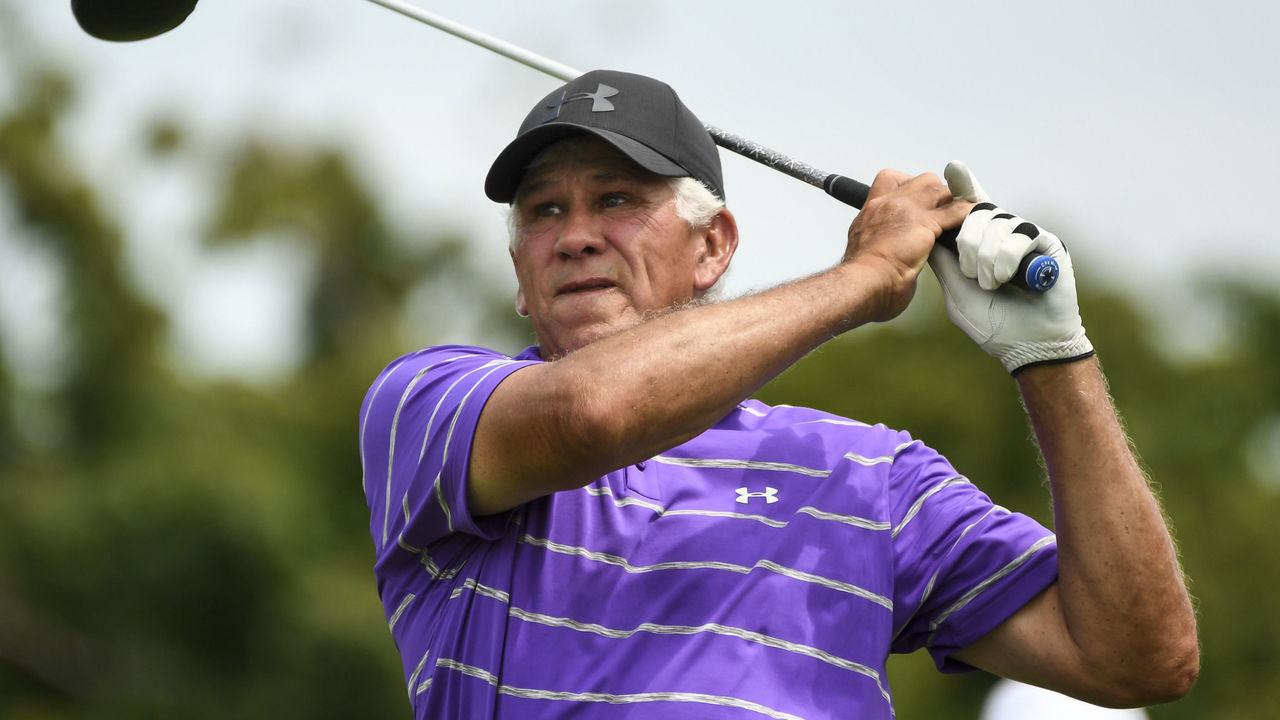
Rick Vaive tees off at Glen Abbey golf course in Oakville, Ontario, in 2018. Minas Panagiotakis / Getty Images
theScore: Why publish a book now? Why not 10 years ago, 15 years ago? Why is November 2020 the sweet spot?
Vaive: It's kind of hard to really give a real answer. I just thought it was time. … When my grandson was born (in mid-2019), I think that was really a big part of it. You realize that you're getting older when you have grandchildren. Plus, you want people to know what your life was all about. I see a lot of people, meet a lot of people, and for the most part, except for the older, wiser generation, everybody thinks, 'Oh, he played in the NHL for 13 years, he must have had a perfect life growing up. Now he's a multi-millionaire.' But it's so far from the truth. I've got a mortgage, for Christ's sake!
theScore: That dynamic is laid out clearly in the book. You list off your yearly salary and, even though you were one of the best players in the NHL, it's obvious you weren't being paid that much, a couple hundred thousand dollars a year. The league has changed dramatically in regard to economics and the amount of money associated with the NHL.
Vaive: Absolutely. The revenues are substantially higher than they were back then. But, at the same time, they made enough money to pay us a bit more in Toronto, for sure. The owners controlled everything, though, and Alan Eagleson (the former executive director of the NHL Players' Association) was on their side. Free agency was 32 years old! He didn't really help us at all. He was in with the owners, and they controlled everything.
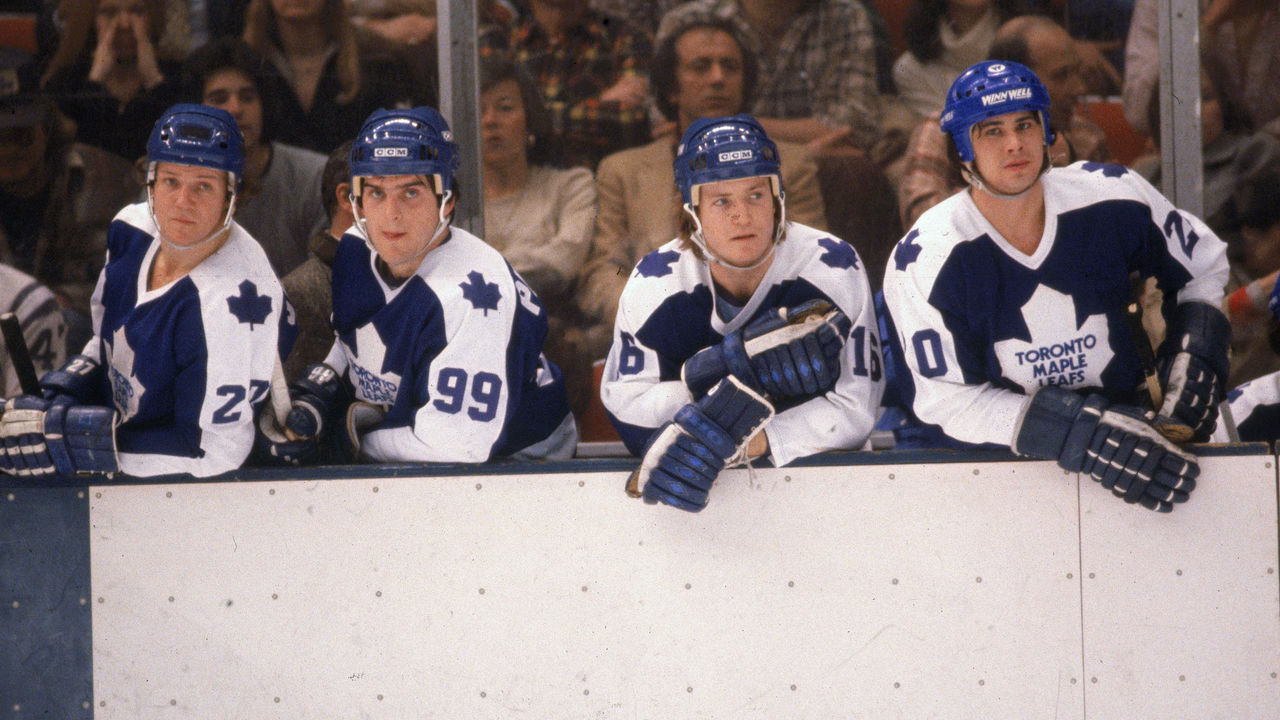
Rick Vaive, far right, and his 1979-80 Maple Leafs teammates. Bruce Bennett / Getty Images
theScore: Speaking of owners, what's the craziest story you can share about infamous Leafs owner Harold Ballard?
Vaive: Oh boy, there's a few. One of the funniest involves his dog, T.C. Puck. He was in our team pictures, which I thought was kind of crazy. I don't have a single team picture without the dog in it. Anyway, T.C. Puck was sitting right in front of me and Harold was beside me. We were sitting there for quite some time. I don't know why, maybe the photographer was moving people around. And then everything got going, we finished, and everybody was getting off the bleachers. The dog tried to get up and it yelped. It turned out his balls were frozen to the ice. So out comes one of the crew members with one of those scrappers and some hot water … (Laughs) Ah, that was pretty funny.
theScore: And then, as an OHL coach, you worked under Don Cherry in Mississauga. You note in your book that he once told you that you "couldn't coach a good f-----g peewee team." Can you describe what Cherry was like as a boss?
Vaive: (Pauses) I don't even know what word to use. Controlling? Controlling. And he's sticking his nose in all the time. That's the way he was. What you see on "Coach's Corner" is what you get with the man himself. It's no different.
theScore: Have you and Don ever patched up the wounds from your time together running the IceDogs? Are you on good terms nowadays?
Vaive: I don't see him very often. I see him at banquets and different things, and I always say hello, how are things, and all of that. I hold no grudge against the guy. It's water under the bridge as far as I'm concerned. Although I think that experience may have affected my ability to get another coaching job. But, you know what, I treat him as I treat everybody else: Very nicely.
theScore: Switching gears, what's your favorite Darryl Sittler prank?
Vaive: The problem is, no one ever knew if it was Darryl or not because he never got caught. He was pretty sneaky. (Laughs) But I know guys who have had their shoes nailed to the floor and the legs of their jeans tied in a really, really tight knot. I would literally sit there for half an hour to get it out. But no one ever caught him. I think we all knew it was him, but you couldn't catch him in the act.
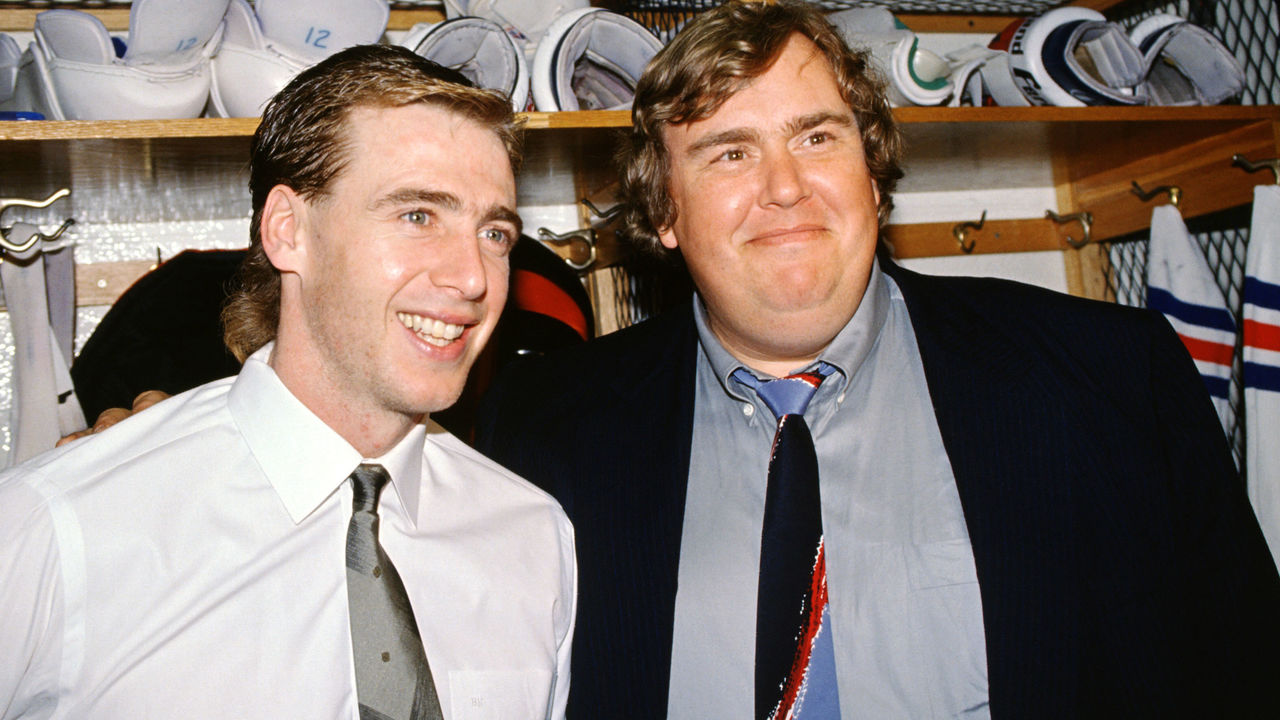
John Candy, right, with Rangers forward Bernie Nicholls in 1990. Bruce Bennett / Getty Images
theScore: What do you recall from your times hanging out with late comedian and actor John Candy?
Vaive: We formed a good relationship. We started hanging out in Toronto and he'd meet some of us Leafs downtown for lunch, stuff like that. I remember really well one time in L.A. He happened to be there, probably working on a movie. I knew he was coming to the game, but I didn't expect him to walk right down into the dressing room. I was in the shower and he's calling for me. 'Where's Squid? Where's Squid?' All the guys are wide-eyed, like, 'Holy cow, John Candy!' I walk out, he's there, we start talking. I get dressed and we go out to the bar. That was kind of a funny story about our relationship. I mean, he was a great person. Funny as hell. Even off the screen. He was just hilarious.
theScore: Was it a charisma thing with John? Would you simply find yourself laughing around him no matter the setting?
Vaive: He would come up with things that you couldn't not laugh at, you know? We were out for lunch and there were three or four of my teammates there, and the whole place would just start erupting. He was just naturally funny.
theScore: In those days NHLers would smoke cigarettes in the dressing room. That mental image is like something from another world at this point, given how far society and hockey have come along with smoking.
Vaive: It was between periods in the bathroom. It's completely different, you're right. I'd say 25% of every team back then probably smoked. Maybe even higher. And now I'd be shocked if there's one player on every team in the NHL who smokes. Obviously, it's not good for you. It's not healthy, and I ended up quitting at 28, I think, because it was starting to affect me, playing-wise. When you look back, it was kind of weird.
theScore: In general, so much has changed on and off the ice in the hockey world since you were an active player. What's one thing you like about the modern game? And what's one thing you don't like?
Vaive: I would say the thing I like the most is probably the way the players are treated. Injury-wise, medically-wise. Everything. They have a solid players' association. Finally, they are getting what they deserve, which is 50% of the (revenue) pie. I guess the least favorite would be the fact they took the red line out. I'd love to see the game with the center-ice red line back in, just so you can't make those passes from beside the net all the way up to the far blue line. It has opened the game up, and it probably is a little bit more exciting, but I would like to see the red line come back in.
theScore: Can you unpack that thought? What do you like about the red line?
Vaive: A lot more thinking would have to go into the game. A lot more strategy, too, in that it's a lot harder to get out of your own zone. Wingers play a more important role with the red line in because they have to do their job along the wall, get pucks out, and that sort of thing. That's what I loved about the game. Defensemen could come down and pinch a lot easier. But now, it's just completely different, and it's hard because if someone blows the zone and the defending team gains possession of the puck, you have to retreat and get back there to stop that long pass.
theScore: Off the ice, you struggled with alcohol, and in 2009 you got pulled over for driving under the influence. The charges were ultimately dropped after a couple of years in the court system but, I'm wondering, how difficult was that time in your life?
Vaive: Those were probably two of the toughest years I've ever had in my life, to be honest with you. I was getting no work, no appearances, nothing. Every time there was a court date, it was everywhere (in the media). That wasn't much fun, I can assure you of that. The outcome (not guilty) was great and a big relief, but the drinking got worse as time went on, even shortly after the trial. But that's when I decided to go to rehab and get help.
theScore: How are you doing these days with your sobriety?
Vaive: I'm fine. We played golf all summer, and my buddies would go on the patio and order a couple of pitchers. I would sit there and drink my ginger ale. I don't think about it that much anymore at all.
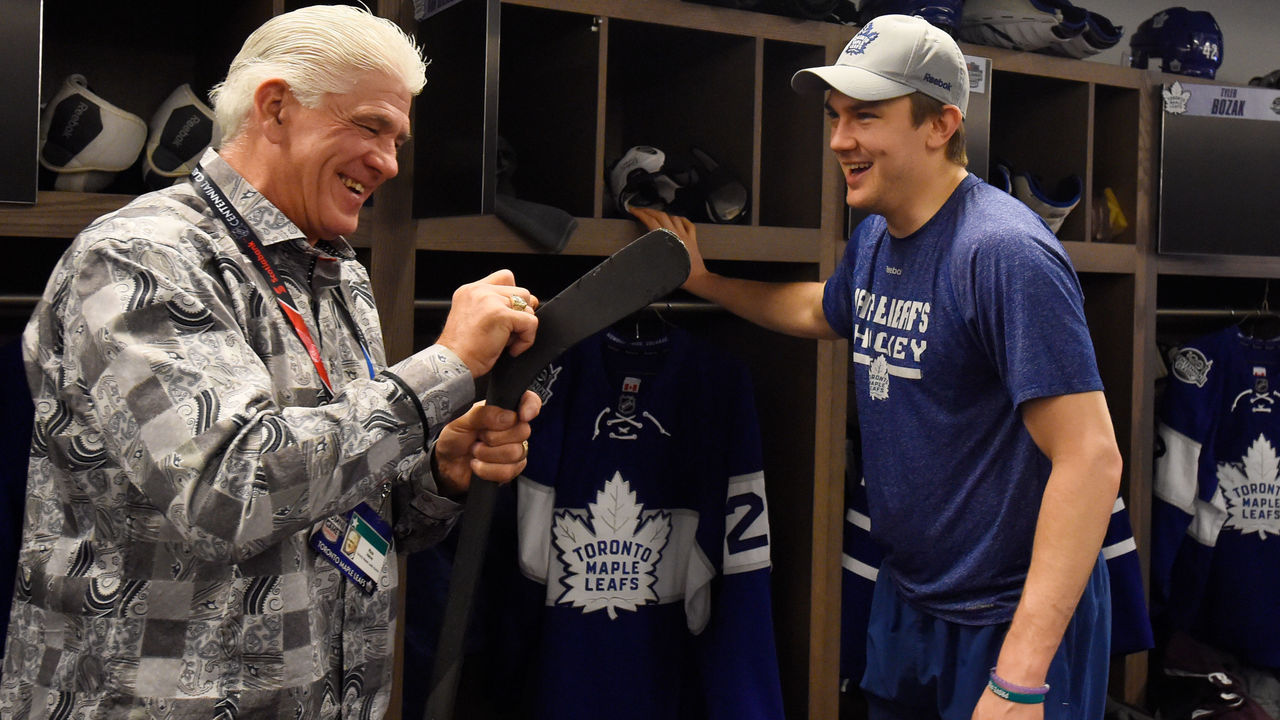
Vaive with former Leaf James van Riemsdyk in late 2016. Graig Abel / Getty Images
theScore: You played for the Canucks, Leafs, Blackhawks, and Sabres in the 1980s and '90s. Those jerseys you wore are now "vintage" looks, especially the "Flying V" in Vancouver. Which of your NHL jerseys did you enjoy the most?
Vaive: (Sighs) I think the coolest one, with the logo and everything, was probably Chicago. That was a pretty impressive-looking sweater in my mind. For the Leafs, I love the one they wear now. I didn't particularly like ours, the ones we wore in the '80s with the blue all the way down the sleeve, similar to the retro one they've come out with recently. And I didn't like the leaf itself. I like the new leaf, which is very similar to the one from 1967.
theScore: What do you think of the moves Leafs general manager Kyle Dubas has made this offseason? Do the Leafs get over the hump in 2020-21?
Vaive: I sure as heck hope so. (Laughs) I think they're good moves, I do. I say that because these new guys have been through it. Some of them have been to the Stanley Cup Final or semifinals, so their leadership will be very, very important. I still think they're all pretty decent players in the league. Joe Thornton is probably one of the best passers in the league.
At the same time, I think the young group, the top-six forwards and top couple of defensemen, has to start taking control of the situation. The guys they brought in are a little bit older, almost near the end. Yes, they're going to be a big part of it, on and off the ice, but if this team is going to get over the hump, it's going to have to be the core guys. They're not kids anymore. They're not too young. They've all played three, four years in the NHL, and they've probably learned a great deal from the last three or four years.
I fully expect guys like (Auston) Matthews, (Mitch) Marner, (William) Nylander to say, 'OK, we have to get this done.' I think, by now, they know what it takes, and I believe they will take over and get this team over the hump.
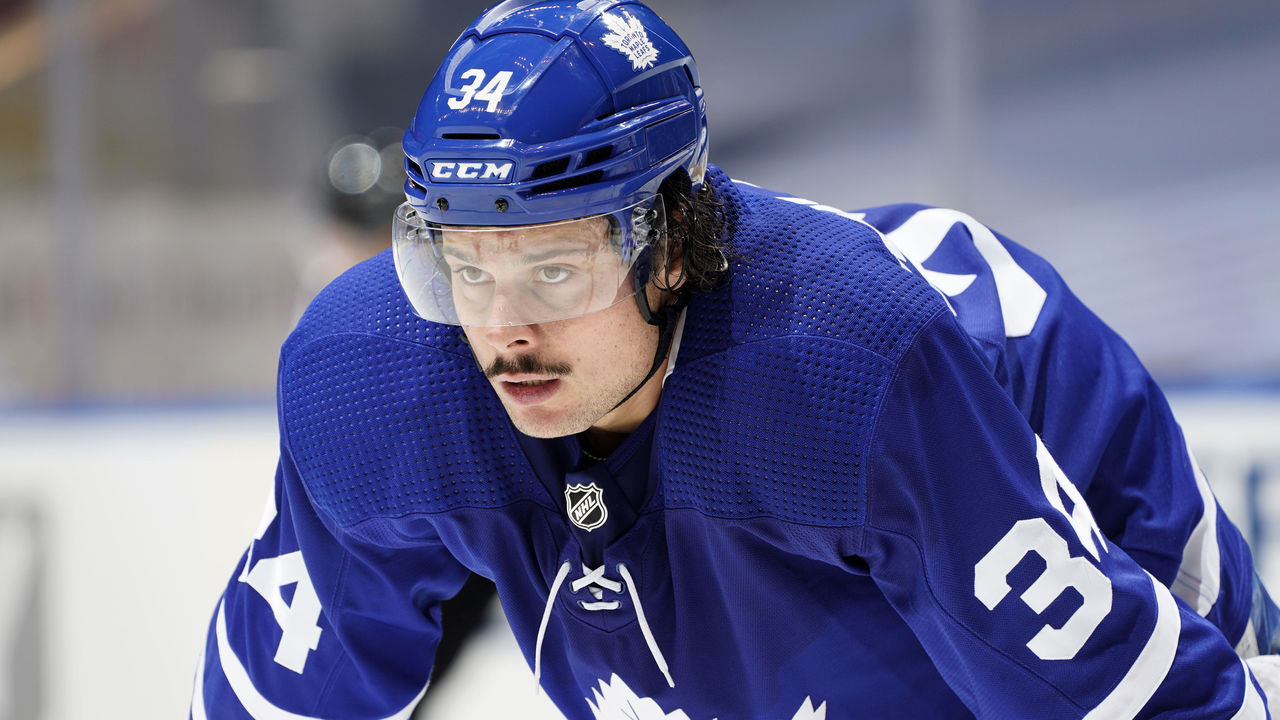
Auston Matthews in August 2020. Mark Blinch / Getty Images
theScore: You've said previously that you'd be happy to see Matthews score 50 and maybe even 55 to break your team record …
Vaive: Well, I didn't say I was happy … (Laughs).
theScore: OK, maybe I'm putting words in your mouth. How would you frame it?
Vaive: No one wants their records to be broken. But, inevitably, they are going to be broken at some point. And Auston was so close last year. He would have scored 50, I'm almost 100% sure of that. Maybe even 54, 55. That opportunity, with 47 goals and 12 games left, was taken away from him. It wasn't taken away from him by injury, which he ran into in his first three or four years. It was a pandemic that took that away from him. I feel bad for him. I would have loved to have been there to watch everything unfold and to see if he could have done it.
theScore: In your mind, what makes Matthews a special scorer?
Vaive: Well, first of all, he's got such an incredible shot. I think his deception, where it looks like he's shooting toward one part of the net and then he changes the angle quickly and puts it somewhere, is special. Besides that, the vision and the ability to read the play is uncanny.
theScore: One final topic: What would it mean to you to have your number 22 retired by the Leafs?
Vaive: It would be a great honor, for starters. I'm at a lot of the games, and I'll look up and see the numbers, and you always think, 'Aw geez, it would be nice to see my number up there …' Yeah, it would be a significant honor. I don't make those decisions, but if it ever happened it would be a wonderful evening and, with my family there and everything, it would be exciting.
theScore: It would essentially be the cherry on top after your career and ambassador work with the team.
Vaive: It would be, but, again, I don't know if it'll happen. If it does, I would cherish it, and it would be a wonderful, wonderful gesture on their part. It would be a heck of an honor.