He was hurt during the Kraken's 5-3 loss to the Edmonton Oilers on Dec. 18.
Details on the 29-year-old's surgery and recovery will be provided at a later date.
Tanev got off to a hot start with Seattle, notching six goals in his first eight contests. Though his production cooled, he currently has the third-most goals on the team with nine, trailing only Jared McCann and Jordan Eberle.
A fan favorite in Seattle, Tanev scored two goals in the Kraken's first franchise win on Oct. 14 against the Nashville Predators, then potted another pair against the Montreal Canadiens in the team's first home victory later that month.
He will end the 2021-22 campaign with 15 points in 30 games.
Tanev was the Kraken's pick from the Pittsburgh Penguins during the 2021 expansion draft.
Boston Bruins winger Brad Marchand isn't pleased with the NHL's decision to opt out of the 2022 Beijing Olympics.
"I think guys have worked their entire lives to put themselves in a position to compete at that level and that opportunity. It should be guys' decisions whether they choose to go or not, regardless of what's happening in the world," he said, per Conor Ryan of the Boston Sports Journal. "The Olympics are on and they're playing and the best players in the world should have that option."
Marchand has never suited up for Canada in the Olympics. If NHL players are allowed at the next Winter Games in 2026, he will be 37 years old.
The NHL committed to allowing players to go to the Olympics as part of the new collective bargaining agreement signed in summer 2020. However, in light of the opt-out, Marchand believes the league never wanted its players at the games.
"It almost felt like they were trying to get out of it for a while and they didn't want us to go," he said.
Marchand added: "I know at the end of the day, they don't care about the Olympics, they don't make money on it, and that's ultimately what this is. It's a business and we're an asset. Let's just call a spade a spade."
The league, NHLPA, IIHF, and IOC confirmed players could return to the Olympics in September, but the deal included an opt-out clause that would allow the league to back out if the regular season was disrupted by the COVID-19 pandemic.
We're approximately a third of the way through the 2021-22 NHL season, and while that's enough time to get real indications of teams' positions in the league hierarchy, the sample size is still small enough that luck plays a factor in a club's standing.
Let's take a look at which teams have benefited - or been hurt - most by luck thus far.
Lucky
Washington Capitals
The Capitals are a very good team. They consistently outperform expected numbers - elite shooting talent allows for that - and they've found ways to pile up wins despite dealing with as many injuries and COVID-19-related absences as almost anyone. They deserve credit.
That said, their results to date are a little extreme. At five-on-five, Washington's high-danger chance differential through 31 games is plus-7. The team has controlled 50.64% of the high-danger chances and 52.94% of the expected goals. Good numbers, but nothing to write home about.
Yet the Capitals lead the league in five-on-five goals, having scored 78 on 64 expected goals. They've also conceded 51 despite giving up nearly 57 expected goals. Those numbers suggest they should be roughly seven goals up. Instead, they rank first in the NHL with a plus-27 differential (78 for, 51 against). Normally, that would be attributed to the shooting ability of Alex Ovechkin and his fellow stars. But Washington has dealt with absences of many of its top guns - and journeymen and unproven prospects have helped maintain top-tier results. I'm skeptical that can continue at this pace.
St. Louis Blues
The Blues have been one of the league's biggest surprises thus far. They own a strong 17-9-5 record and rank just outside the top 10 in points percentage. It's hard to argue they're deserving of such a record.
St. Louis has controlled just 47% of the expected goals at five-on-five. That's good for 24th in the NHL, sandwiching the Blues between the Kraken and Blue Jackets. Not overly impressive, is it?
Even after accounting for special teams, the Blues sit below a 50% share in almost every key metric. They've gotten by on high shooting and save percentages.
I don't expect the wheels to fall off. But I'd be surprised if St. Louis is still in the mix for first in the Central Division by the end of the year.
Unlucky
Seattle Kraken
You can't spell unlucky without the Kraken ... or something like that. Seattle has enjoyed the success - or lack thereof - you'd generally expect from an expansion franchise. The team has won just 10 of 30 games thus far, and on many occasions, its chances of winning disappeared by the end of the opening frame.
Part of that is because the Kraken lack high-end talent, especially up front. But extremely poor luck has played a major role as well.
Philipp Grubauer's contract was always a bit of a gamble; future performance is hardest to predict in goaltenders. Betting big on someone who will be on the wrong side of 30 for the entirety of a deal is risky, to say the least. But nobody could have foreseen Grubauer's struggles thus far.
Before this season, he had logged at least 17 appearances in seven NHL seasons. His save percentages in those years: .925, .918, .926, .923, .917, .916, .922. Those are sparkling numbers.
Even after accounting for a move from a juggernaut Avalanche squad to an expansion franchise, nobody could have envisioned an .882 save percentage through 23 games. Those are numbers you'd expect from a mediocre AHLer called up due to injuries.
Is poor performance really luck? In this case, I'll say it is, at least for Seattle. The team had every reason to expect - at the very least - average goaltending. Grubauer has never provided less. And yet he's cost the Kraken game after game, even contests they've played well in.
Seattle might not be a good team, but it's unlucky to be this bad.
New Jersey Devils
The Devils have plenty of problems. Their power play is the worst thing I've ever seen, and they lack true finishers. Those two problems were always going to limit what this team could accomplish.
But a quick glance at some key numbers suggests New Jersey is better than 10 wins in 30 games. The Devils are above 50% in expected goals share at five-on-five and look very good in terms of high-danger chances. They've generated 290 high-danger opportunities, tying them with the Panthers for sixth in the NHL. That has amounted to no success.
New Jersey sits fifth in high-danger chance share (54%) at five-on-five. Actual goal share? The club is at 44.35%, good for 27th.
Even after accounting for those issues, the Devils' underlying performance is closer to that of a fringe playoff team than one expected to contend for a top pick.
Todd Cordell is a sports betting writer at theScore. Be sure to follow him on Twitter @ToddCordell.
"When Goalies Were Weird" is a six-part narrative podcast about 1990s-era NHL goalies. In the '90s, the position was undergoing a revolution in style and substance, as the butterfly goalie replaced the stand-up while advancements in equipment technology helped usher in a modernized, more athletic playing style. The old guard's quirks and the new guard's innovations melded together to produce an era of pure chaos in the blue paint.
Jim Carey stockpiled individual awards before quitting the game in his mid-20s. Damian Rhodes stood out as eccentric on a team filled with superstitious players. Garth Snow talked trash without remorse and fought enforcers. Martin Brodeur was a transcendent talent whose jolly presence made him unique. These are their stories.
To hear the full episode, click here to listen on:
(Note: This excerpt has been lightly edited for clarity and length.)
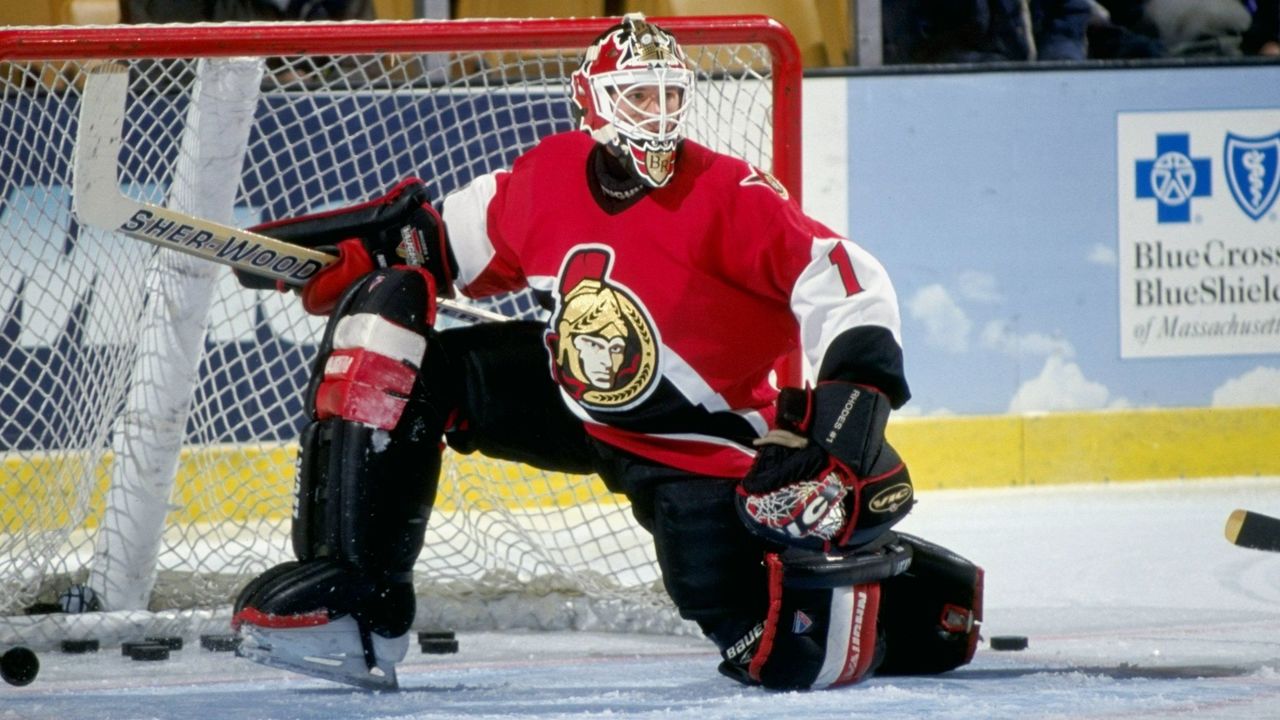
Damian Rhodes was never Vezina- or Stanley Cup-caliber. What makes him a memorable 1990s-era goalie, then? His zaniness.
Rhodes, who played 10 NHL seasons for the Toronto Maple Leafs, Ottawa Senators, and Atlanta Thrashers, was a character who did offbeat things and got himself into abnormal situations. One example: He's one of six netminders to have scored an NHL goal without shooting the puck.
When Rhodes and the Senators met the New Jersey Devils in the first round of the '97-98 playoffs, he was rocking a leopard-skin jockstrap under his equipment. He also had blond locks under his goalie mask, having dyed his hair that March and simultaneously gone on a heater, winning nine of his last 14 regular-season starts as the Senators clinched a playoff spot.
Teammates, and even kids around Ottawa, bleached their heads. After Rhodes stonewalled the Devils, Sports Illustrated nicknamed him the "Peroxide Kid."
Brian Babineau / Getty Images
Throughout his time in Ottawa, Rhodes' quirks tended to surface when the Senators hit the road. According to former defenseman Lance Pitlick, Rhodes packed exactly one suit per game, reluctant to repeat an outfit.
Another Ottawa alumnus, blue-liner Jason York, roomed with Rhodes at the team hotel. That's how he learned about - and came to depend on - the goalie's so-called "sleep machine."
"It was one of those, I don't know, dehumidifiers," York recalled. "It didn't even work, but it made some kind of noise. And he had to have it, or else he couldn't sleep.
"So I got used to it. I said, 'Damian, you bring the sleep machine with ya?' He goes, 'I got it, Yorkie. I got it in my bag here.' It kind of sucked because after - when I got a different roommate - I didn't have it anymore, and I was a little bit lost without a sleep machine."
One thing Rhodes didn't do was look up at the jumbotron during games.
This was to avoid seeing the opponent's shot count. Rhodes didn't want to give in to the urge to calculate - then obsess over - his save percentage while pucks zipped around him.
Rhodes has an explanation for his jockstrap, by the way.
His preferred brand of cup was produced by a goalie equipment company called Brian's. And when Brian's introduced a line with funky designs, Rhodes saw the leopard-skin pattern and thought, "I've got to have THAT."
The connective thread between these mannerisms and peculiarities is that they got Rhodes into the right headspace. He wasn't a player who could diversify what he did on game days and show up at the rink ready to stare down clappers.
It may have looked weird, but controlling certain things is what calmed his nerves and cleared his mind.
"I know when I was playing, a lot of people called it superstitions," Rhodes said. "And I hated that because I just felt like it all brought luck in the game.
"Some guys could do whatever they want. They could have a submarine sandwich that day, or they could take a five-hour nap and still show up. But I wanted to keep it as routine as possible. And I felt like those things were ultimately what got me in my routine. And yeah, it's a little crazy, I would say."
To hear the full episode, click here to listen on:
Edmonton Oilers superstar Connor McDavid has joined the growing list of players who have expressed their disappointment with the NHL's decision to pull out of the 2022 Winter Olympics in Beijing due to COVID-19 concerns.
However, rather than lament another lost opportunity to compete on the world's biggest stage, the Oilers captain offered up a potential solution.
"They pushed the Summer Olympics back one year, maybe that happens again this year," McDavid said while meeting with the media, according to Oilers beat reporter Tony Brar. "Obviously it’s not looking that way, I think we do need to find a way to get a best-on-best tournament done at some point here.
"We can't go six, seven, eight years without playing best-on-best. I'd like to see something worked out if the Olympics don't get pushed."
This will mark the second straight Winter Games that NHL players will miss after the league didn't go to the 2018 Olympics in PyongChang.
The 2016 World Cup of Hockey was the last best-on-best hockey tournament. McDavid was captain of Team North America, which boasted a talented roster from the United States and Canada aged 23 and under.
McDavid said another World Cup of Hockey would be a "great second option," but there is no true substitute for the Olympics.
"I think you want to play at the Olympics because, for me, it's the biggest stage in sport," he said. "The Olympics is a stage that's on such a global scale and I think everybody wants to play on that stage."
TSN's Pierre LeBrun reported on "Insider Trading" earlier this month that there won't be a World Cup of Hockey in February as there isn't enough time to plan for an event of that scale.
The club previously placed Sam Bennett, Radko Gudas, Ryan Lomberg, Brandon Montour, Carter Verhaeghe, Aaron Ekblad, and Frank Vatrano on the COVID-19 list before the season paused on Dec. 22.
Huberdeau leads the Panthers with 33 points in 29 contests this season. Weegar ranks second on the team with 23:55 minutes of ice time per game.
The Panthers are slated to take on the New York Rangers on Wednesday night. Florida last played on Dec. 16 against the Los Angeles Kings.
The NHL and NHLPA have formalized a number of CBA exemptions to give teams battling COVID-19 cases some roster relief, reports Sportsnet's Elliotte Friedman.
Teams that would dress fewer than two goalies, six defensemen, or 12 forwards for a game will now be permitted to make emergency recalls as long as the cap hit of the player does not exceed $1 million.
If a team's two regular goaltenders are not available, the club will be allowed to add an additional netminder.
Teams will also have the option to use taxi squads until the All-Star break, which is slated for Feb. 5. The taxi squad can have a maximum of six players on it at once and players can only be on it for 20 days or less.
Players can’t be on the taxi squad if they're on an NHL roster as of Dec. 22; are waiver-exempt; were on an NHL roster for at least 75% of the regular-season days or have played in 16 of a team’s last 20 games through Dec. 22.
The NHL began its holiday break early by pausing all games on Dec. 22 amid an outbreak of COVID-19 cases across the league. Games are expected to resume on Tuesday.
Toronto has the second-most players in protocol among NHL teams, trailing only the Calgary Flames as COVID-19 cases continue to spike around the league.
The NHL originally postponed three Maple Leafs contests from Dec. 16-19 and eventually paused all games from Dec. 22-26. It announced Friday that all games on Dec. 27 have also been postponed.
Toronto last played on Dec. 14 and is next scheduled to face the Pittsburgh Penguins on Dec. 29. The Maple Leafs have had five games postponed so far.
In the lead-up to the 2022 World Junior Championship, we're looking back at the 25 best players to wear the Canadian jersey at the tournament. Rather than evaluating entire careers, these rankings are based solely on performances during the world juniors. We have revealed five players each day, culminating here with the best of the best.
Jonathan Toews may not have cracked the list after notching just nine points in 12 games while taking home two gold medals, but he did deliver one of the most memorable moments in Canadian world junior history in 2007.
With Canada facing the archrival United States with a crop of immensely talented players on both sides, the semifinal game went to a daunting shootout. The lengthy duel went seven rounds, and Toews came up clutch by scoring on all three of his attempts - including the game-winner. Those heroics created a memory that will last a lifetime for most Canadians.
5. Ryan Ellis (2009, 2010, 2011)
GP
G
A
19
5
20
Ellis medaled in all three world junior tournaments he played in, collecting one gold (2009) and two silvers (2010, 2011). He's one of four players in Canadian world junior history to win three or more medals, and he did so while scoring at a ridiculous rate for a defenseman.
He was named Canada's captain in 2011 and was eventually named the best defender at the tournament. With 25 points across three events, he remains the highest-scoring blue-liner in world junior history.
4. John Tavares (2008, 2009)
GP
G
A
13
12
8
Tavares helped lead Canada to its fourth and fifth consecutive gold medals, playing a major role in both triumphs. He produced four goals and an assist across seven games in 2008 before piling up eight markers and six helpers over six contests the next year. Tavares set up Jordan Eberle's dramatic tying goal in the 2009 semifinal and scored in the shootout to help Canada advance to the gold-medal game.
The dynamic center was named MVP and top forward at the 2009 tournament. Tavares is one of three players tied for second among Canadian skaters in all-time world junior goals and sits seventh on the country's all-time world junior points list.
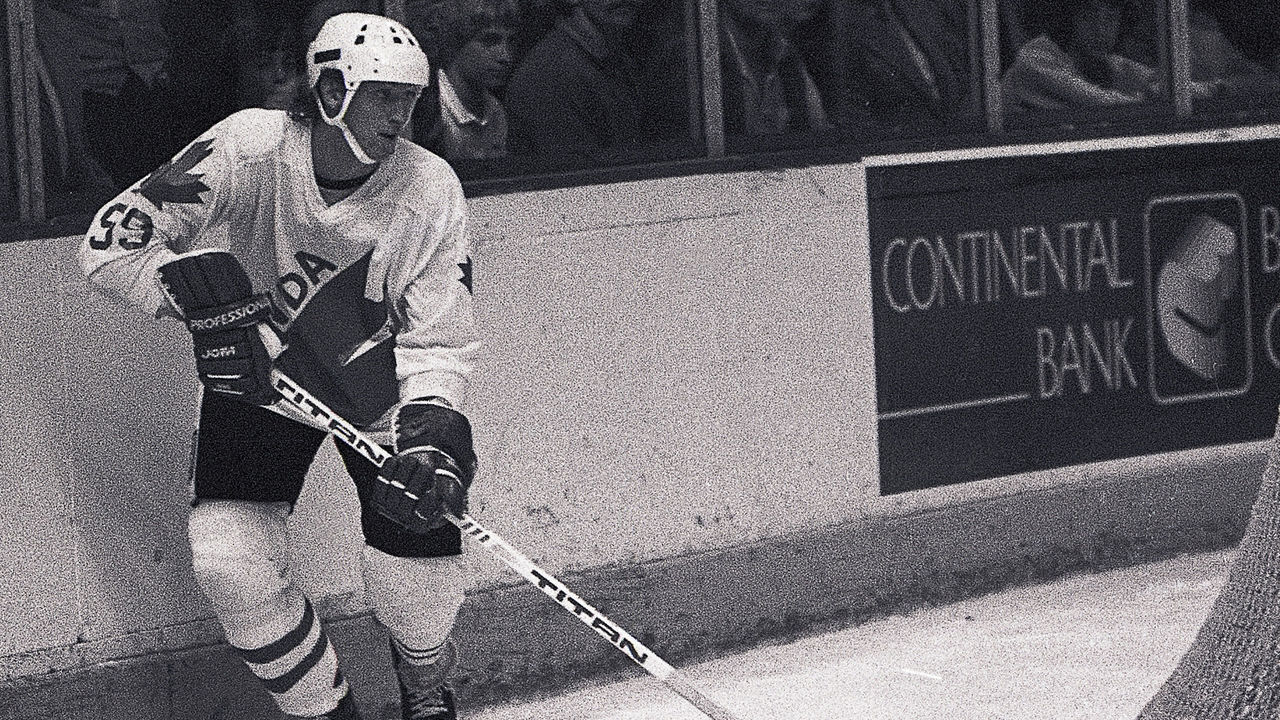
3. Wayne Gretzky (1978)
Denis Brodeur / National Hockey League / Getty
GP
G
A
6
8
9
Gretzky only appeared in the tournament once, but he put on an incredible show. He led the 1978 event with 17 points despite being the youngest player and still holds the record for most points in a world junior tournament for a 16-year-old.
Canada settled for a bronze medal that year, but Gretzky couldn't have done much more to help the team. He was named the tournament's best forward but never returned to the world juniors. Imagine what he could have accomplished if he played another year or two.
2. Eric Lindros (1990, 1991, 1992)
GP
G
A
21
12
19
Lindros was one of the most highly touted prospects in NHL history, and his world junior performances did nothing but skyrocket his stock. "The Big E" won two gold medals, first cracking the Canadian roster as a 16-year-old in 1990 and registering four goals in seven games. Lindros recorded a combined 27 points in the following two events to become Canada's all-time leading world junior scorer.
1. Jordan Eberle (2009, 2010)
GP
G
A
12
14
12
"Can you believe it!?"
That epic call by TSN's Gord Miller is arguably the most iconic moment in world junior history. With Canada trailing 5-4 against Russia in the 2009 semifinal, Eberle scored the game-tying goal with just five seconds left in regulation. After Tavares shoveled the puck toward the net, Eberle showed incredible poise in front, going to his backhand and elevating the puck rather than trying to jam it in.
It's often forgotten that the game-tying tally was Eberle's second goal of the contest. He also scored the shootout winner for good measure. Eberle then registered a goal and two assists in the final against Sweden, helping Canada win its fifth straight gold medal at the tournament.
Eberle nearly pulled off similar heroics a year later. With Canada trailing 5-3 with under three minutes left in the gold-medal game against the United States, Eberle scored not one, but two goals to force overtime. It was not to be, though, as John Carlson won it for the U.S. in the extra frame. Despite falling short of another gold medal, Eberle was named tournament MVP.
While the clutch moments alone make him an easy choice for No. 1 on this list, Eberle also has the stats to back up his ranking. He sits second on Canada's all-time world junior scoring list and fifth in points per game.