Despite defeating the Columbus Blue Jackets by a modest score of 3-2, the Bolts put on a dominating performance in Game 3 to take a 2-1 lead in the series.
The Lightning held the Jackets to a staggering seven shots in the final 45 minutes of the game, according to The Athletic's Aaron Portzline.
Tampa Bay ran into penalty trouble early in the game, as Pat Maroon, Zach Bogosian, and Blake Coleman were each docked two-minute minors in the opening 10 minutes. Columbus generated some chances, but couldn't capitalize on the power plays. Once the game returned to five-on-five, the Lightning took over.
The Bolts finished the game by controlling 74.2% of the shot attempts at five-on-five and had 13 high-danger scoring chances compared to Columbus' two, according to Natural Stat Trick.
Blue Jackets head coach John Tortorella chalked it up to overall fatigue for his group, having played eight games in 14 nights. Three of those contests went to overtime, including the quintuple OT marathon in Game 1 of the Lighting series.
"That’s the kind of thing that determines it for me, is it wasn’t just one person," Tortorella said postgame, according to Brian Hedger of the Columbus Dispatch. "It was a whole group of men that struggled tonight.”
Robin Lehner won the opening two games of the series while posting a .911 save percentage, but the Golden Knights have a quick turnaround with Game 4 scheduled less than 24 hours after Game 3 at 6:30 p.m. ET on Sunday.
The Golden Knights will be without Paul Stastny for Game 3 after he was deemed unfit to play. However, Max Pacioretty will make his return to the lineup following his absence from Game 2.
The Carolina Hurricanes' Twitter account has no time for Jack Edwards' homerism.
The Boston Bruins broadcaster tweeted that Andrei Svechnikov was at fault for the injury the forward suffered during Game 3.
What NBC hasn’t shown yet, regarding the unfortunate injury to Svechnikov: the Carolina wing playing hobby-horse, riding Chara on the back apron of the goal. You poke the bear, you take your chances. No one wanted to see Svechnikov hurt, but he bit off more than he could chew.
This isn't the first time Edwards has made light of a potentially serious injury. Dallas Stars defenseman Roman Polak was stretchered off the ice after going headfirst into the boards during an October contest against the Bruins. Edwards said the injury was a result of "bad hockey karma." Polak's agent, Allan Walsh, responded by calling Edwards a "piece of shit and an absolute disgrace." Polak had to be taken to the hospital and was diagnosed with a small fracture in his sternum.
Edwards is widely considered the worst play-by-play commentator in hockey. The NESN announcer and Andy Brickley ranked last in The Athletic's April survey on the best local NHL broadcasts.
Svechnikov is a significant piece of Carolina's offense, and he had logged seven points in five postseason games while averaging over 17 minutes per contest entering Saturday's clash.
The second-year sniper notched 24 goals and 37 assists in 68 regular-season games before the pause.
Boston held on to win the game and take a 2-1 series lead.
"I want to be with my teammates competing, but at this moment there are things more important than hockey in my life, and that is being with my family," the star netminder said in a statement.
"I want to thank the Bruins and my teammates for their support and wish them success," he added.
Shortly thereafter, Bruins general manager Don Sweeney implied he wasn't blindsided.
"I don't think it's any big surprise to us," the GM told reporters on Saturday, including NHL.com's Amalie Benjamin. "... This has been a difficult decision for Tuukka. The Boston Bruins are in full support of why he made this decision."
"The priority has to be his family and we support that," Sweeney added, before confirming Rask's family is healthy and the goalie's decision isn't related to anything specific.
Following Boston's 3-2 loss to the Carolina Hurricanes in Game 2 of their first-round series Thursday night, Rask said "it doesn't really feel like playoff hockey out there," adding that "it feels like playing an exhibition game" and it's "dull at times" without fans in attendance.
The Hurricanes offered well wishes before Game 3 on Saturday afternoon.
We sincerely hope everything is OK and wish Tuukka and his family the best. There is nothing more important than those we love.
Rask is a finalist for the Vezina Trophy this season after winning the award in 2014. The veteran puck-stopper helped the Bruins win the Presidents' Trophy in 2019-20, posting a .929 save percentage - which led the NHL among goalies who played more than 30 games - and five shutouts in 41 contests, all of which were starts.
His wife recently gave birth to the couple's third child.
"I want to be with my teammates competing, but at this moment there are things more important than hockey in my life, and that is being with my family," the star netminder said in a statement.
"I want to thank the Bruins and my teammates for their support and wish them success," he added.
Shortly thereafter, Bruins general manager Don Sweeney implied he wasn't blindsided.
"I don't think it's any big surprise to us," the GM told reporters on Saturday, including NHL.com's Amalie Benjamin. "... This has been a difficult decision for Tuukka. The Boston Bruins are in full support of why he made this decision."
"The priority has to be his family and we support that," Sweeney added, before confirming Rask's family is healthy and the goalie's decision isn't related to anything specific.
Following Boston's 3-2 loss to the Carolina Hurricanes in Game 2 of their first-round series Thursday night, Rask said "it doesn't really feel like playoff hockey out there," adding that "it feels like playing an exhibition game" and it's "dull at times" without fans in attendance.
The Hurricanes offered well wishes before Game 3 on Saturday afternoon.
We sincerely hope everything is OK and wish Tuukka and his family the best. There is nothing more important than those we love.
Rask is a finalist for the Vezina Trophy this season after winning the award in 2014. The veteran puck-stopper helped the Bruins win the Presidents' Trophy in 2019-20, posting a .929 save percentage - which led the NHL among goalies who played more than 30 games - and five shutouts in 41 contests, all of which were starts.
His wife recently gave birth to the couple's third child.
If upsets are in the offing in the Western Conference’s round of 16, don't expect them to come courtesy of the Blackhawks or Coyotes.
Spunky efforts kept those teams within a goal in Game 2 losses, but they won't ward off the inevitable. Chicago's defense is leaky - fodder for the Golden Knights' relentless attack. Darcy Kuemper's a tremendous goalie, but the Avalanche profit from mismatches everywhere else on the ice.
Surprise play-in round victories were already more than Chicago and Arizona would have gotten out of a typical postseason. Soon their presence in the Edmonton bubble will be a bizarro memory.
So the onus falls to the Canucks and Flames to try to prosper as underdogs out west. They've looked considerably more complete - defending tenaciously and scoring in droves most nights - than Edmonton and Nashville, higher seeds that the 'Hawks and 'Yotes vanquished in the qualifiers. And several days into the first round, they each have inside track on authoring momentous upsets of their own.
Jeff Vinnick / Getty Images
These Canadian clubs' paths to the Stanley Cup quarterfinals run through the offensive end. The Stars and Blues tend to lock it down defensively. Dallas netminders Ben Bishop and Anton Khudobin form an elite tandem; St. Louis' Jordan Binnington ascended to that form at times during last year's Cup run. Yet the Flames and Canucks have gotten to them, helping deface save percentages that in Bishop and Binnington's cases now sit at .862 in this small playoff sample.
They've employed different approaches to achieve this objective, a vital development against squads that are built to thwart and frustrate opposing playmakers and snipers. Friday's results - Calgary's 2-0 shutout of Dallas and Vancouver's 4-3 defeat of St. Louis in overtime - delivered them to within two wins of a common prize.
Offensive opportunism is Vancouver's secret sauce. That the Canucks didn't put a shot on target over a 12-minute stretch of Game 2 conformed with the control the Blues exerted overall. That they won anyway was a testament to the speed with which their go-to players can strike.
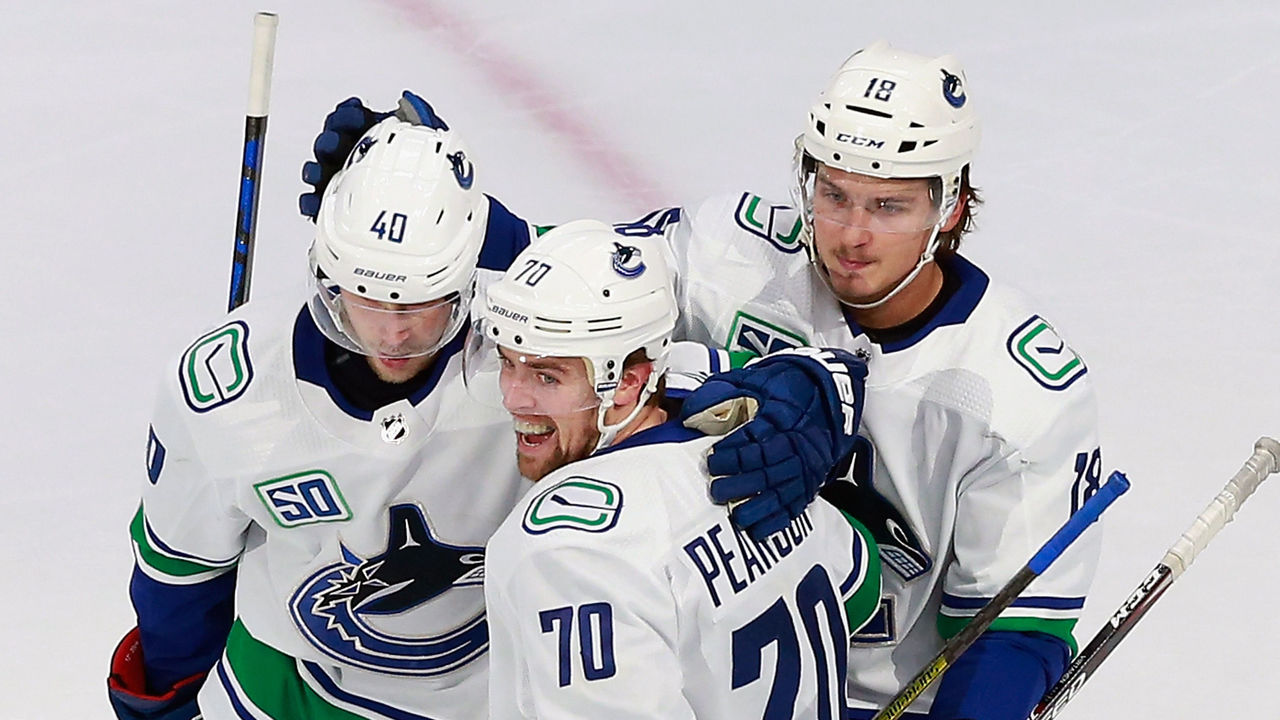
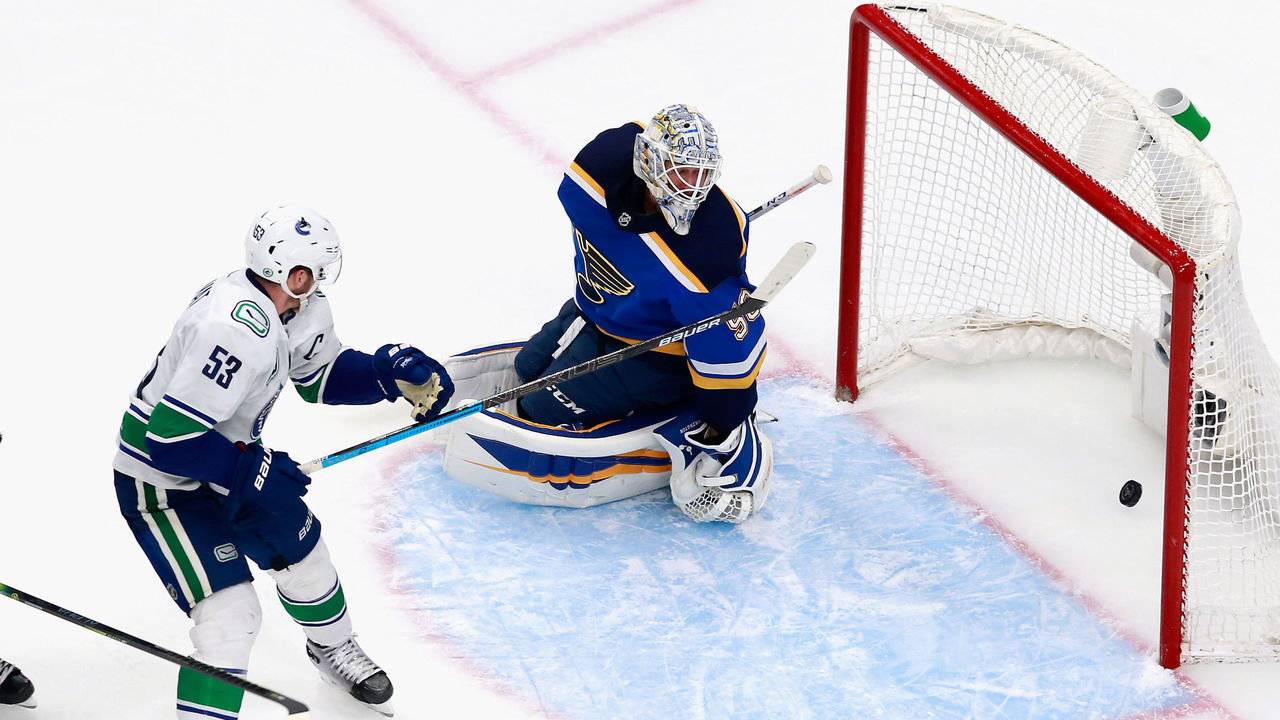
We saw it when Elias Pettersson went to work on the power play - first as his saucer pass set up Tanner Pearson for a one-timer in the slot, then as he batted an airborne rebound past Binnington. We saw it on two of the prettiest rushes Bo Horvat has ever converted: his undressing of Brayden Schenn and Jaden Schwartz to open the scoring and his five-hole finish in overtime off Quinn Hughes' great breakout feed.
Jeff Vinnick / Getty Images
Indeed, this brand of clinical play characterized all four Canucks goals - as it also did J.T. Miller's disallowed breakaway marker, the veteran straying a step offside in his haste to deke Binnington moments after he exited the penalty box.
Already the Canucks have cashed five power-play goals in this series. Their best unit - Pettersson, Horvat, Miller, Brock Boeser, and Hughes - moves on a string, rotating rhythmically and passing with precision, waiting for gaps to open in danger areas. Accounting for all phases of the game, five Canucks have scored multiple goals this postseason, led by Horvat's six and Pettersson and Pearson's three apiece, with Hughes (one goal and seven assists) playing the part of expert orchestrator.
Vancouver's quick-hit nature contrasts with the physicality and collectedness that St. Louis has used to generate way more shot attempts at even strength (107-72 overall, per Natural Stat Trick). The Blues don't waste chances to test Jacob Markstrom - or to body Pettersson and Hughes near the boards. Here, the Canucks' young stars have been opportunistic, too. Witness Pettersson drawing the interference penalty on David Perron that led to his goal, or Hughes accepting that this Tyler Bozak check was a reasonable trade-off to create Horvat's winner.
While Vancouver's big guns have led the charge, the story of Calgary's start to the playoffs has been that of any and all sources scoring however they can.
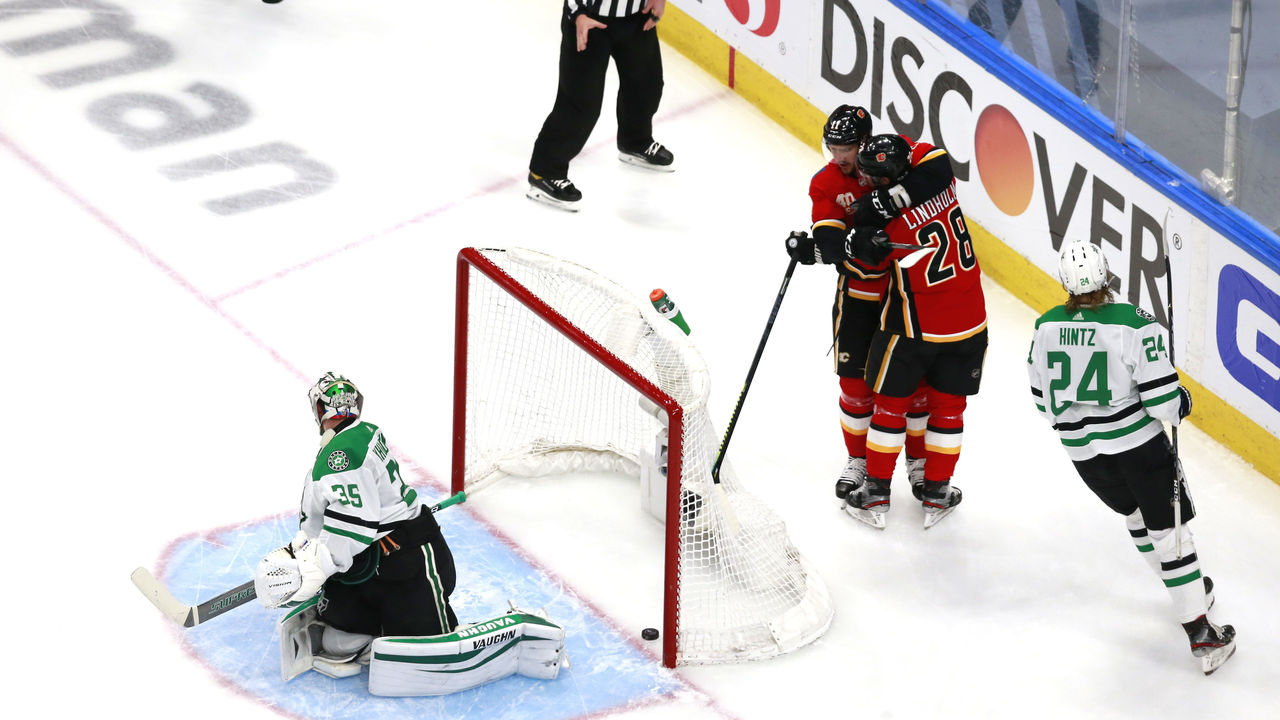
Thirteen Flames have tickled twine over seven games. In the city where Tobias Rieder infamously went scoreless in 2018-19 - becoming Oilers CEO Bob Nicholson's scapegoat of choice for a lost season - the German winger's potted two shorthanded breakaway goals. His second came in Game 2 against Dallas, the same night defensive rearguard Derek Forbort - who last scored in March 2019 - stunned the bubble by netting a knuckler from the point.
Those depth contributions, a vastly different modus operandi from Vancouver's top-heaviness, have done a lot to compensate for the silence of Calgary's top two forward lines, whose six usual members still have yet to score on the Stars at even strength. Who would have guessed that that group's Game 3 breakthrough would come via a workmanlike shorthanded goal from Mikael Backlund? Or that T.J. Brodie's insurance tally would arise from - of all situations - a fourth-line faceoff win in the offensive zone?
Jeff Vinnick / Getty Images
Calgary would be down in this series if those sequences didn't bear fruit - and, pertinently, if Cam Talbot wasn't spotless in net with 35 saves. Dallas absolutely slammed the Flames at five-on-five, doubling their shot attempts (56-27) and tripling their scoring chances (27-8), according to Natural Stat Trick. Astoundingly, those margins were 33-5 and 18-0 in the second period.
Aside from his Game 2 stinker, Talbot's steadiness in the bubble has unquestionably been huge for Calgary. The Flames still needed someone to score to win, of course, and should their goalie falter, they've proven they have the manpower to MacGyver a solution.
Similarly, the Canucks' defensive structure warrants mention before we move onto Game 3. By collapsing into a shell, jamming lanes, and blocking plenty of shots, the skaters in front of Markstrom have lessened the burden he'd otherwise face during the Blues' sustained O-zone time.
But it's the offense that has them two games up on St. Louis, a defending champion on a five-game playoff skid. Against heavy pressure, Vancouver's performance suggests opportunism can be a lethal countermeasure - so long as the counter belongs to a team more talented than Chicago or Arizona.
The first round of the Stanley Cup Playoffs is heating up. Here are three key takeaways from the Eastern Conference games on Friday's schedule, which included a 5-0 pounding of the Philadelphia Flyers by the Montreal Canadiens and a decisive 5-2 New York Islanders victory over the Washington Capitals.
Relentless Ovi not enough
Elsa / Getty Images
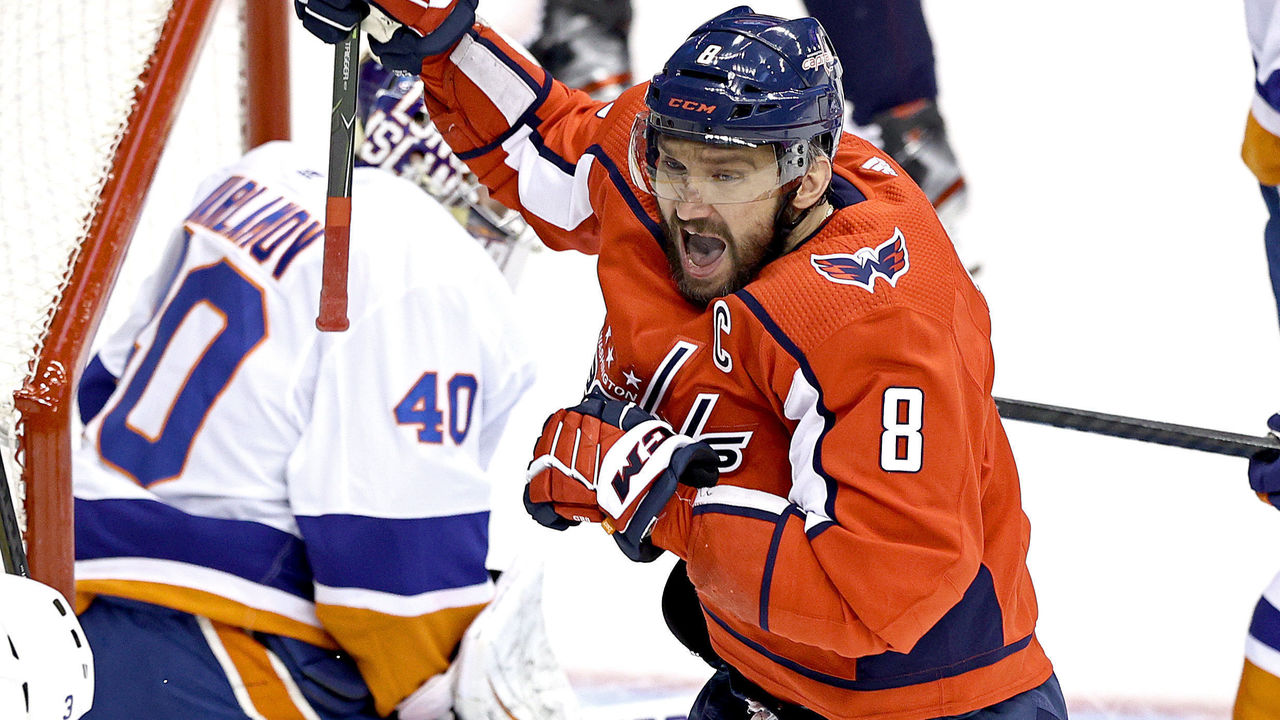
If Alex Ovechkin's nifty goal 56 seconds into the first period and the subsequent noisy celebration didn't convince Barry Trotz and the Islanders that Relentless Alex Ovechkin came to play Friday night, what followed certainly did.
On his next shift, right in front of the Isles' bench, Ovechkin blurted out what sounded like an "oh, c'mon!" loud enough for everyone in Scotiabank Arena to hear after a linesman accidentally halted a potential odd-man rush for him and linemate Evgeny Kuznetsov. That fieriness deep inside Ovechkin - which was not always present in the Caps' four previous postseason games - didn't really leave until the final buzzer sounded. He looked every bit like a man on a mission.
"We needed a big game from him tonight," Caps head coach Todd Reirdon said postgame. "He's physical, he's able to convert a couple of different ways for us. I thought he had a strong game from his perspective and we need more players like him that are playing to the top of their level."
Alas, Ovechkin - who scored both Caps goals - couldn't propel his squad past New York all by himself. The Isles now lead the best-of-seven series 2-0.
Full marks to New York for dictating the pace and style of play in Game 2. The Islanders put Washington on its heels for most of the night, mercifully carrying out textbook coach Trotz hockey: smothering, physical, and unified.
"They're very disciplined and they stick to it throughout the game," Caps defenseman John Carlson said of the Isles, who gave Washington only two power-play opportunities. The Caps, meanwhile, were the opposite of disciplined, gifting the Isles five power-play chances. They shot themselves in the foot, twice getting assessed a minor for too many men.
Ovechkin, who skated for more than 22 minutes in the loss, managed to record 10 shot attempts, including six that reached New York goalie Semyon Varlamov. Ovechkin had laser focus, deployed his trademark short, chopping strides, and yapped away. Leo Komarov, one of the Isles' better defensive wingers, tried to glue himself to the Russian's hip as best as he could, but Ovechkin bounced around the rink like a ball of energy.
Maybe too much energy. Ovechkin's best chance in the third - a wide-open shot off a back-door feed from Kuznetsov - hit the side of the net.
"I just missed it," he said. "Shit happens."
Habs must bottle this
Chase Agnello-Dean / Getty Images
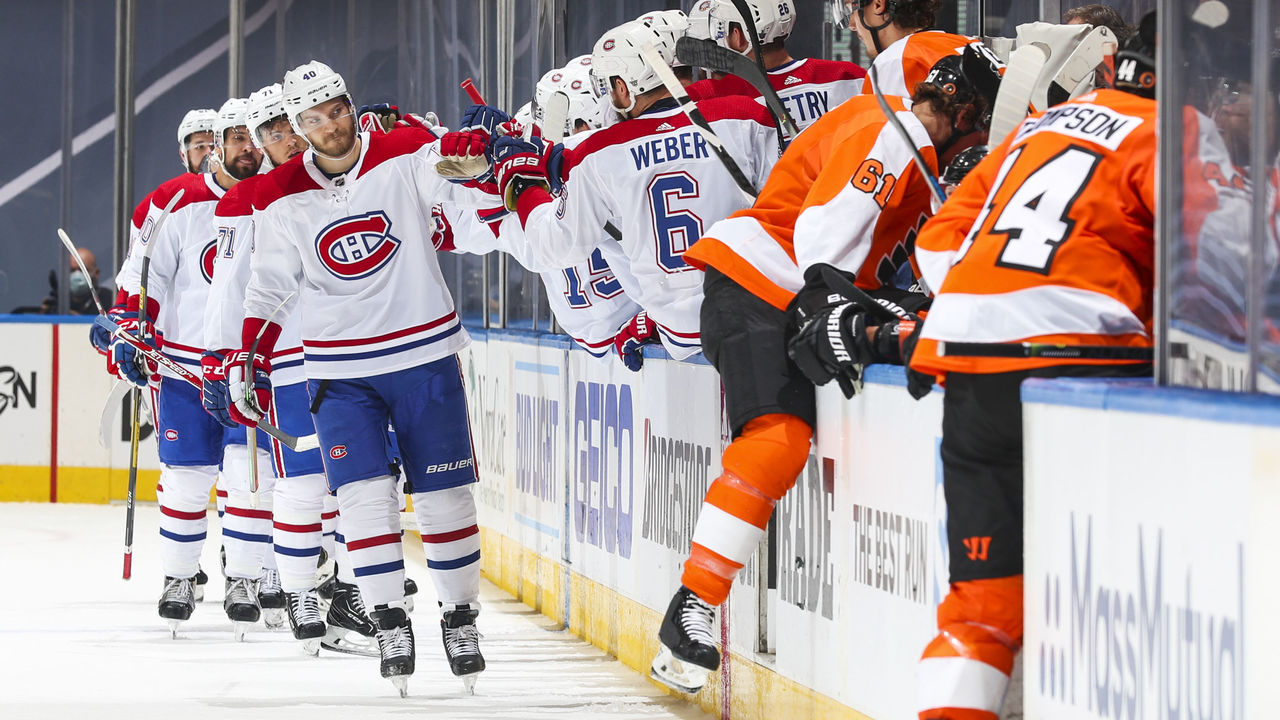
Max Domi hit the bullseye following the Canadiens' dismantling of the Flyers on Friday. In his media availability, Domi noted the commanding 5-0 Game 2 win was both "just one game" and "a huge step in the right direction for us."
Couldn't have said it better myself for a Habs team that finds itself tied 1-1 with a really strong Philadelphia squad despite selling pieces at the trade deadline. Without head coach Claude Julien, who is back in Montreal recovering from a health scare, the Canadiens displayed their true potential as a collective against the Flyers.
Goalie Carey Price was flawless, turning aside all 30 Philadelphia shots. Montreal's forwards played with a sense of urgency and completed passes with precision from the opening faceoff onward, accounting for the game's first 12 shots on goal and 32 total. Tomas Tatar and Jesperi Kotkaniemi both scored twice, while Domi seemingly flew up and down the ice on every shift.
"We got our butts kicked today in all facets of the game," Flyers coach Alain Vigneault said. "They outworked us, outplayed us, and outexecuted us."
"We're doing it in numbers," is how Kirk Muller, Montreal's associate coach and Julien's temporary replacement, explained his group's inspired showing. In Muller's eyes, everyone who dressed for the Canadiens on Friday played well. That gave him the freedom to roll out four forward lines and three defensive pairs. The Flyers simply had no answer for a team that played like a wrecking ball, especially when Habs captain Shea Weber was on the ice.
"It's nothing new," Ben Chiarot, Weber's defensive partner, said of his teammate's domination. "This is something he's done his whole career. We're talking about 14, 15 years of being one of the best defensemen in the NHL."
It was one of those games where the better team had more giveaways (18-9 for Montreal) because it had the puck the whole time. The Canadiens eventually chased phenom Carter Hart from the Flyers' net before running over backup Brian Elliott moments later. Bottling up this emotional, well-earned win for Julien will be the tricky part, and it's no small task given Montreal is usually no world-beater.
"When we stick to our game plan," Domi said, "we skate, we have everyone going, and we're a very tough team to play against."
The key word there is "when."
Don't sleep on Suzuki
Mark Blinch / Getty Images
Columbus Blue Jackets center Pierre-Luc Dubois is enjoying a postseason coming out party thanks to four goals and four assists in seven games. So is Miro Heiskanen, the Dallas Stars blue-liner who's opening eyes across the continent with a combination of effortless skating, defensive prowess, and swagger with the puck. Kotkaniemi, who's bagged four goals to pace Montreal, would also count as a breakout player.
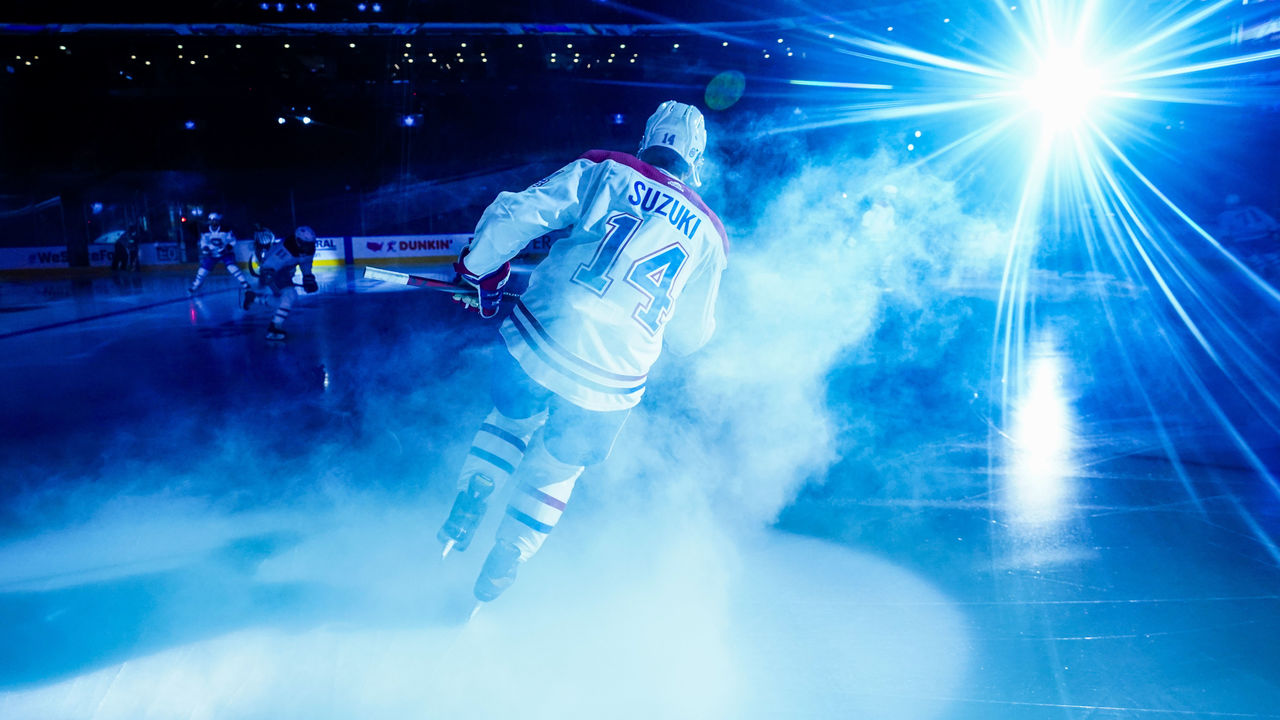
What about Nick Suzuki, though? The unflappable Canadiens rookie should be in the conversation as one of the best up-and-comers of the restart. He's arguably been as impactful as Kotkaniemi.
Suzuki, who was drafted 13th overall by the Vegas Golden Knights in the 2017 NHL Draft before being sent to Montreal in the Max Pacioretty trade, has one goal and two assists in six games. However, his contributions are mostly subtle, extending beyond the boxscore.
The 21-year-old ranks second in ice time among Montreal forwards, skating for 19 minutes and 46 seconds per night. The coaching staff trusts Suzuki, just 77 games into his NHL career, to play in any and all situations: up a goal, down two goals, on the power play, on the penalty kill, at even strength, whatever.
"Suzy's starting to tap into playing some big minutes against some high-level talent on the other side," Domi said following Friday's win. "It takes a lot of confidence to do that. It's a tough job to do. He showed it in the first round and he's showing it again, tonight and in Game 1."
Suzuki has mainly faced off against difficult assignments in Sidney Crosby, Evgeni Malkin, and Kevin Hayes thus far, yet he's been on the ice for just one goal against at even strength and has a plus-2 rating. A responsible pivot, he has terrific poise and above-average hand-eye coordination. He's already the rare NHLer that coaches never have to worry about - a master of the little things who is more than willing to, for instance, take a pounding body check to get the puck out of harm's way. And it doesn't hurt that he has some scoring touch, too, as evidenced by his 13 goals and 28 assists in 71 regular-season games.
Suzuki will be lucky to sneak into the top five in Calder Trophy voting. The 2020 rookie class was deep, starting with super studs Quinn Hughes and Cale Makar, and continuing with Dominik Kubalik, Adam Fox, John Marino, Elvis Merzlikins, and Victor Olofsson, plus a few others. But the probable top-five snub shouldn't discount what Suzuki has accomplished both during the regular season and his breakout postseason.